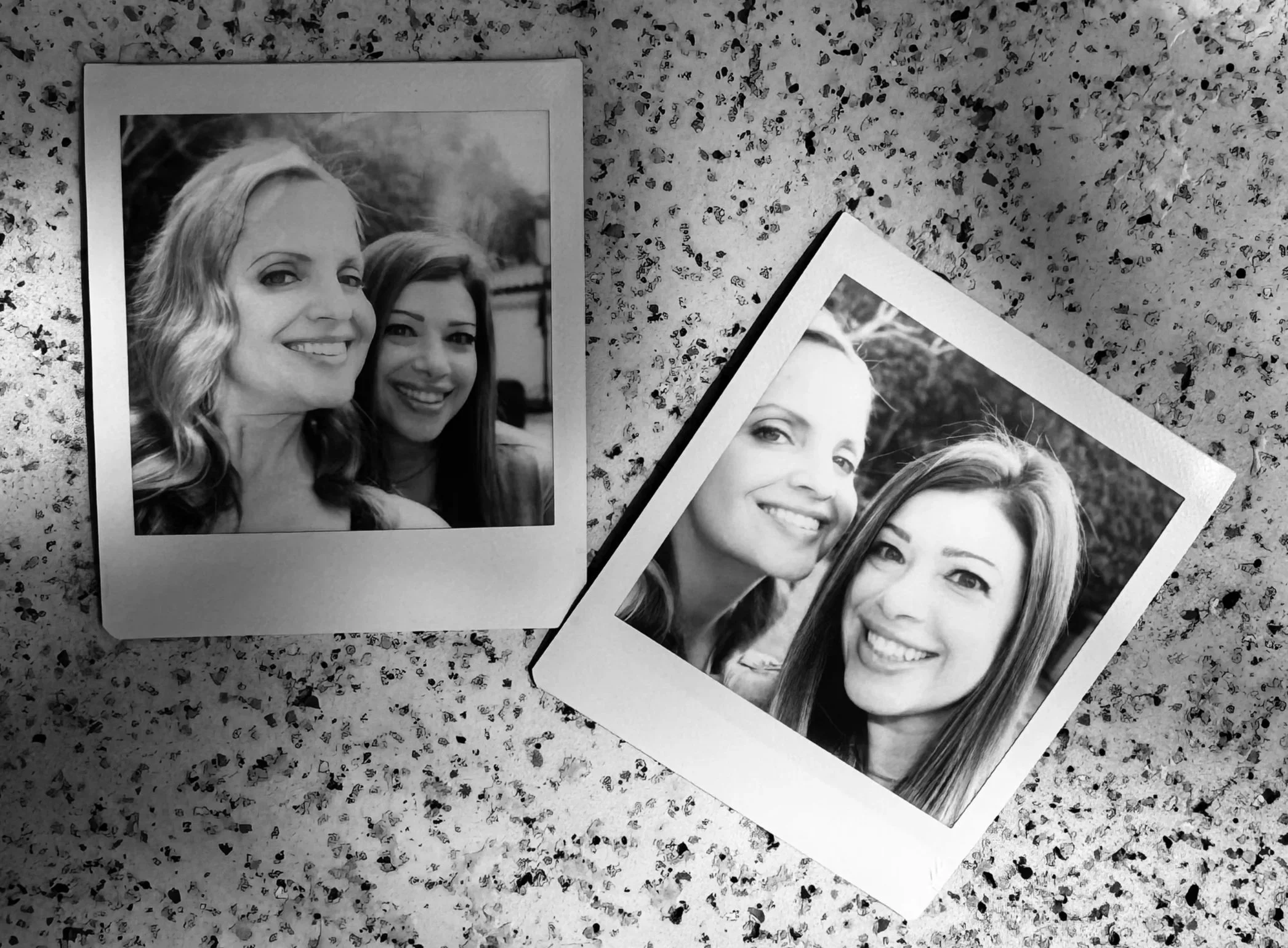

In Conversation: Mena Suvari & Nola Singer
Mena Suvari and Nola Singer both came of age in Los Angeles, but their lives didn't intersect until later in life when both were looking for a reset.
“I definitely felt, kind of, taken in and spit out by so much of the Hollywood machine,” says Suvari, an Emmy-nominated actress who became a household name at twenty thanks to the critical and commercial success of the Oscar-nominated film “American Beauty” and hit comedy “American Pie" in 1999. “A lot of people can fall victim to that because there’s so much pressure.”
Singer remembers being equally frustrated in her styling career when a childhood friend — Oren Segal, now a talent manager — introduced her to his client, Suvari.
“I was disillusioned,” Singer recalls of that pivotal moment, ten years ago, when she and Suvari met for a meal to discuss the possibility of working together. “Hollywood’s hard, and I love being creative, but sometimes when you get to a [certain] level, it stops being creative. … I had some clients I was still working with, but I was questioning my life. And then, [Mena and I] really connected.”
After meeting — and clicking — professionally in 2016, their relationship inevitably turned personal as Suvari and Singer realized they have a lot in common beyond a mutual love of fashion.
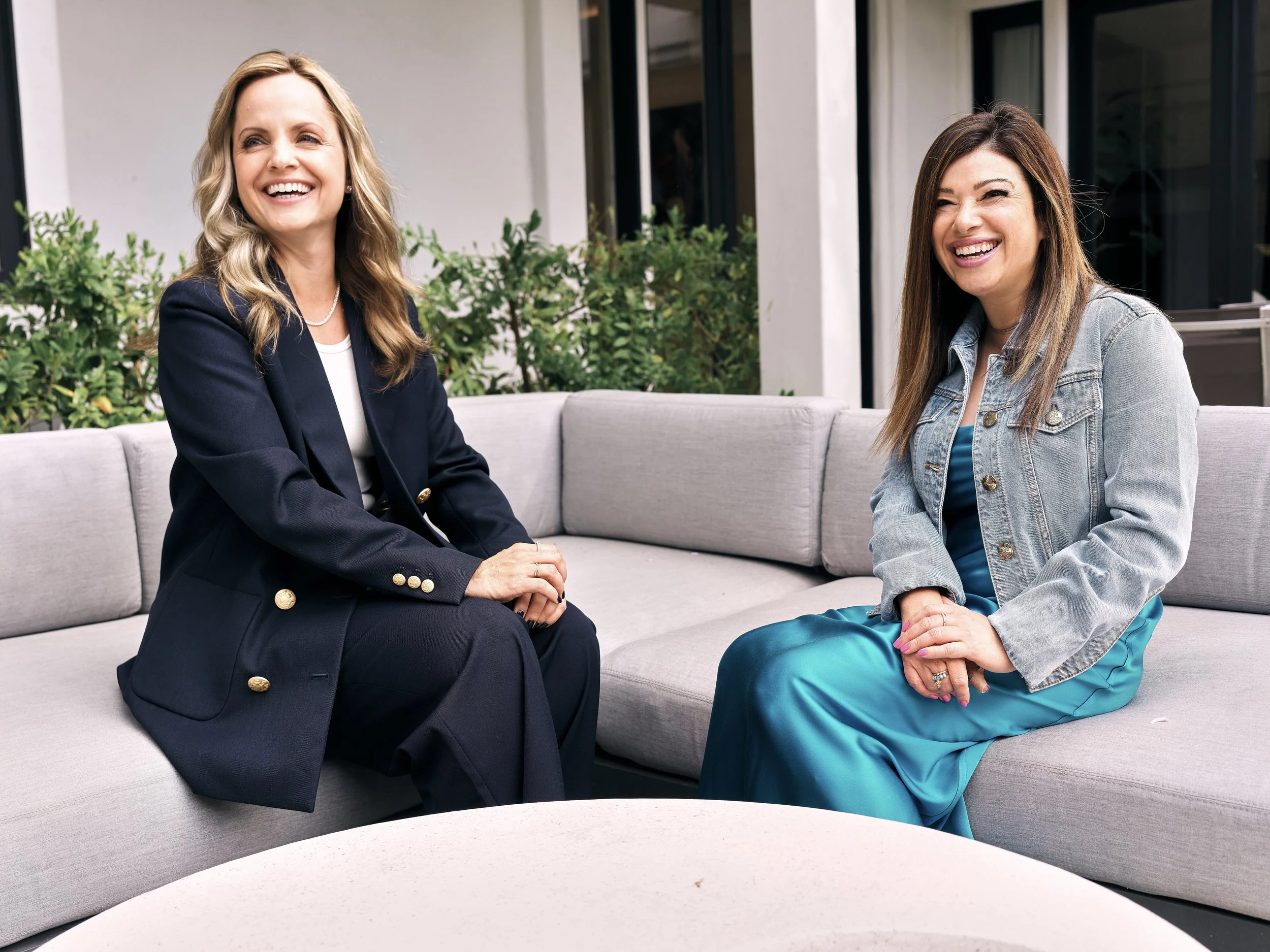
“There’s this L.A. connection when you're young, growing up here,” says Singer seated on a couch at a private Southern California home. “It’s unlike any other place, and we grow up fast.”
“Oh, yeah,” Suvari agrees. “I came from Charleston, South Carolina. From an all-girls school. In ’94.” She attended Notre Dame High School in Sherman Oaks for two years. “I tried to fit in by getting the Dr. Martens that everybody was wearing with their private Catholic school uniform,” she laughs. “I would be in detention a lot because I would violate the dress code.” Suvari then transferred and graduated from Providence High School in Burbank between acting and modeling gigs.
“So you grew up really fast,” Singer says, alluding to Suvari’s cover girl status in the early aughts.
“After ‘American Pie’ and ‘American Beauty,’ in my early twenties, I had an emotional breakdown,” Suvari reflects. The actress says she debated going to college but kept booking work including follow-up films for the “American Pie” franchise as well as 2000's “Loser,” the cult classic “Sugar & Spice,” and “The Musketeer” with Catherine Deneuve, both 2001. Since then, Suvari has also starred on 2004’s “Six Feet Under,” 2011’s “American Horror Story: Murder House,” 2013’s “Chicago Fire,” and 2018’s “American Horror Story: Apocalypse,” in addition to a slew of other television and film projects.
Meanwhile, Singer—whose father, Marty, is a prominent Los Angeles attorney and mother, Deena, a philanthropist and longtime supporter of the Rape Treatment Center and Stuart House—grew up in close proximity to the entertainment industry. (Her sister, Jacqueline, is a screenwriter while her brother, Grant, is a filmmaker who has directed music videos for Lorde, Sam Smith, and Shawn Mendes in addition to the 2023 feature film “Reptile,” which he co-wrote with the film’s star Benicio Del Toro.)
But Singer always had more of an interest in fashion. After attending college at Loyola Marymount University, working in retail, and assisting Halle Berry’s then-stylist Phillip Bloch, Singer started dressing friends including Naomie Harris and Sophia Bush.
Of Singer’s knack for styling, Suvari tells her, “You’re collaborative, but you also have a strong vision. I’ve learned so much through you. We’re very much on the same page, which is crazy, and that’s when the magic happens.”
The women say they’re grateful to have found one another when they did. “I’m super into the universe, and I feel like you're meant to meet people,” says Singer, an animal rescue advocate who is also the founder of Rescue Rosé, a blush wine whose proceeds benefit animals in need. “You and I were destined to cross paths, and I love that it happened sooner [rather] than later.”
Suvari agrees and shares a story about her current manager, Oren, to underscore her shared belief in destiny. “Oren said that when he was just starting out [in talent management], we crossed paths at L’Ermitage,” Suvari says, explaining they didn’t wind up working together until several years later in 2016. “I didn't have a manager for a very, very long time. I had an agent who did everything. Apparently, I was leaving the meeting with that agent as Oren was walking in to meet him. I remember [later] thinking, ‘God, I would have loved to have worked with you then.’”
“That’s very ‘Sliding Doors,’” Singer adds. “I don't know if you saw that movie ‘Sliding Doors?’ It’s one of my favorites. One part, she misses the elevator. And then the other part, she doesn’t, and [the movie follows] how her life turns out differently.”
“If only I had met you then, too,” Suvari tells Singer. “[But] I do believe what you're saying. That goes for so much of what I believe in and how I think things truly work. But you have to be ready for those moments. You have to be in that particular place and receptive to that person. So it does come in at the right time. If it’s meant [to be], then it lines up.”
Their partnership turned friendship has since become a family affair of sorts — as evident on the day of their shoot with The Retaility. Towards the end of their conversation, Singer’s mother and sister stop by.
“I wanted to say hi,” Jacqueline says as Deena offers them smoothies. Singer explains that Suvari is attached to a comedy, “Kill Me Now,” which Jacqueline wrote with Suvari in mind.
“By the way, I’m not just saying I wrote it for her,” Jacqueline insists. “I know people say that.” She looks at Suvari. “You were always in my mind [as the lead character]. Always.”
“Oh. Me?” Suvari says, laughing. “I thought you were talking about her.”
“You think I wrote a part where I make out with my own sister?” Jacqueline says.
They all laugh. This is how much of the insightful afternoon unfolds with joy, fashion, and real talk. “Nola is in the hotter seat,” Suvari teases. “I wrote a book about my life, so [I'm ready to go deep].”
Read on for more about their early L.A. origins, respective careers, the joy of collaborating with one another, and much more...

MENA SUVARI: Had we met before Oren?
NOLA SINGER: No. Oren set us up at a lunch at Gracias Madre.
MENA SUVARI: What was the first thing that you heard about me? Did he call you?
NOLA SINGER: I don't remember, but [I thought] you were really cool and an Aquarius. I'm an Aquarius as well, and so is Oren. And [he said] you needed a new stylist. I was actually thinking about stopping styling at that point, and our meeting went so well. We really connected. You were into sustainable fashion and finding new designers, and you were so creative and cool. I was like, ‘Wait, this actually sounds really fun,’ and I loved how you were so cool and down to earth, but also knew what you wanted. You were really clear.
MENA SUVARI: How long had you been styling then?
NOLA SINGER: I’ve been styling on and off for 20 years. I don't know. I can't do math. But a long time.
MENA SUVARI: Were you with different agencies? Did you make [it happen] yourself?
NOLA SINGER: I had an agent. I started out on my own working in retail, and then I had a boyfriend in a band. I styled them.
MENA SUVARI: Oh, wow.
NOLA SINGER: The lead singer's girlfriend was an actress, and I started styling her.
MENA SUVARI: That was your first stuff?
NOLA SINGER: I worked for Phillip Bloch. I was his assistant, and I learned from the best. He's amazing. I assisted, and then I started getting my own clients because I have friends who are actresses too. And then they were like, ‘Can you help me?’
MENA SUVARI: And then you would meet other designers? Because you have such an incredible relationship with designers and also these showrooms. That’s important.
NOLA SINGER: It’s also that they want to dress you.
MENA SUVARI: Oh, thank you. But it’s also about you. [How] did you meet those people? [What were the] stepping stones to get there?
NOLA SINGER: Also, I request [things because] I know your press schedule, and I'll be like, ‘This would be great [for]…’ Like when you went to TIFF, and you wore that Dolce & Gabbana dress, I knew that was going to work for you — depending on the event, and then the designers are like, ‘Oh, we want to dress her.’
MENA SUVARI: But when you were starting out, was it a lot of just giving it a shot to reach out to people and see if they respond? How did you get that information?
NOLA SINGER: You e-mail them, or you call them. Or you go to showrooms.
MENA SUVARI: Did you stalk anyone to get information?
NOLA SINGER: Definitely. I am a stalker, but I'm a nice stalker. I literally write, ‘Sorry for stalking.’ I think that might be my signature. ‘Sorry for stalking you, but I need that dress.’
(FASHION) SHOP TALK
MENA SUVARI: Because what's interesting to me, what I've learned over the years, is that a lot of those people… Please correct me if I’m wrong. But the turnover rate is so high. A lot of the people that you meet within those fashion designer companies or showrooms are always changing. So if you have a connection somewhere, that person might not be there anymore.
NOLA SINGER: That happens, but it's a small industry. They usually go to different showrooms and work together. I also think they like your client. They like what you do. It’s a trust at the end of the day. Like, Sezane gave us this suit [you’re wearing today].
MENA SUVARI: We love Sezane.
NOLA SINGER: We love Sezane. But we didn’t style it naked. We styled it with a tank top, great Melinda Maria jewelry, a Sydney tank top, and great shoes. We could have ruined it if we put [on] a tutu top. It is about working with people they know are going to look good in their clothes and stylists they trust will do right by the look. That's why relationships are important.
MENA SUVARI: Is that stuff that you learned or saw go wrong? Because I saw some things go wrong [when I worked with other stylists before we started working together].
NOLA SINGER: I think I just have an eye. I never want you to wear something that wears you. I want to see you, and I want to make your job easier when you're promoting something where you feel good, where the outfit makes you feel pretty, but not where you're like, ‘Oh my strap keeps falling, or I can't breathe.’ I want you to be comfortable, and I want people to see you [and to never feel] like, ‘What is she wearing? It's so overpowering,’ where they don't look at you. They’re looking at that.
MENA SUVARI: {sarcastically} I haven't had any moments like that.
NOLA SINGER: You haven’t. Not with me.
MENA SUVARI: I'm just talking about in my career. {sarcastically} You can't find any of that online.
NOLA SINGER: You always look beautiful.
MENA SUVARI: Thank you, but I've been worn [by a dress].
NOLA SINGER: I want it to look like you.
MENA SUVARI: Something has worn me [many years before you].
NOLA SINGER: When you’re smaller and also when you are working with fashion, there are some things designers create that are runway or more photo shoot [appropriate] versus if you’re working or [for] a red carpet. Like a photo shoot, you want to wear something more dramatic.
MENA SUVARI: Did you find yourself being uniquely honest?
NOLA SINGER: Did you find me being uniquely honest?
MENA SUVARI: In a profession that's not so honest because…
NOLA SINGER: Yeah. I try to be honest.
MENA SUVARI: Because I’ve had a lot of those moments [of people not being honest].
NOLA SINGER: It’s also trust. I think why we get on so well, there's a trust [between] us, and I know you well.
Mena Suvari: Because I had to learn the hard way, and then I experienced what was possible [by working with you]… Your mom is looking at us. I love your mom.
NOLA SINGER: {she calls out} Mom, we're videoing. I love you.
FRIENDS WHO ARE LIKE FAMILY
MENA SUVARI: Not only is Nola amazing, but her family is amazing. This is one of the reasons I love you. And that's why I bring up Oren, because I work with his brother as well.
NOLA SINGER: Yeah, he's great. Best realtor.
MENA SUVARI: It's so nice to have that support, but it feels like family. And I'm attached to a project with your sister.
NOLA SINGER: Which is the best thing ever.
MENA SUVARI: It's so special because you don’t always find that. I know that for a fact because I've experienced such a plethora of ways that things can be done, and experienced all of that and learned the hard way. It’s so nice to be [in good hands]. I’m so comfortable where I’m at now, and I know that really ties into our relationship. I mean, you give so much to me. You teach me so much. You really care, and you're a friend, and that goes beyond just working with me or styling. It really goes into everything else that you do.
NOLA SINGER: Thank you. Well, same for you. I mean, also, to get to work with someone you genuinely like and care about? It is a trust thing. It is a gift.
MENA SUVARI: I made Nola do this today.
NOLA SINGER: She did. I did it because I love [The Retaility’s founder] Lindzi and I love you, but I did not want to be in photos or videos.
MENA SUVARI: She doesn’t like to talk about herself.
NOLA SINGER: Nope. Whatever. But I'm glad we did it. Hopefully. But it is a gift. Also, nine years? I feel like time flies when you're having fun because we have done so much. I mean also, COVID makes time so weird.
MENA SUVARI: It’s true. We lost time with COVID.
THE COVID ERA
NOLA SINGER: You’re always working. [Even during COVID.]
MENA SUVARI: We were set to go to an event [right before the world shut down].
NOLA SINGER: I remember. We went to the LoveShackFancy [dressing]. Remember? We went to the bungalows. We picked out dresses, and we thought we were going. They were having a dinner.
MENA SUVARI: Yes! That’s what it was!
NOLA SINGER: We thought we were going, and then we got the email…
MENA SUVARI: It was literally that day.
NOLA SINGER: They shut it down. They were like, ‘We’re canceling the dinner,’ and you had the most gorgeous dress. Whatever happened to that dress?
MENA SUVARI: And I remember it was an intimate event. I remember thinking, ‘What is this shutting down? This isn't going to happen.’
NOLA SINGER: We thought we were still going. We were like, ‘They gifted us these dresses. We’re going to this dinner.’ And then it was canceled that morning.
MENA SUVARI: There was literally a fashion event the day COVID [hit].
NOLA SINGER: Nobody had [any] idea what was going on.
MENA SUVARI: That’s wild. So we lost years, and then I got pregnant. Did you style me [for something during that]? You know I have no memory anymore.
NOLA SINGER: Yeah, we did that L.A. Times shoot at your house.
MENA SUVARI: After the birth. That was a lot of fun.
NOLA SINGER: We worked [during] COVID because you had your book. We did all the book press.
MENA SUVARI: I had to do that, and I remember recording the audiobook for the book four months after [my son] Chris was born.
THE HOLLYWOOD MACHINE
MENA SUVARI: I learned the hard way [that not everyone is looking out for you in this industry] with all that kind of stuff. Because, I mean, I'm not trying to speak poorly of anyone, but I definitely felt, kind of, taken in and spit out by so much of the Hollywood machine. It is what it is, but a lot of people can fall victim to that in a way, because there's so much pressure on your look or the brand to such an extent that it's [paralyzing]. I never wanted to live in fear, and that's something that can very much happen. But for sure, I was kind of pushed to [work with different people]. I’ve worked with different stylists. I’ve worked with very, very well-known, high-end stylists. And I was so young. I've probably gotten to know myself the most in the last year, and I’m 46. Can you imagine [me] at 20? Or 18, 19?
NOLA SINGER: But at least you found yourself. Some people never find themselves.
MENA SUVARI: Thank you, but what I mean is…. I was just so caught up in it, and I was so impressionable that I feel like… You could look back on my life and my career, and you could very much see that [in photos from that time]. I would be in something that was wearing me. Or I was pushed to wear a particular designer or go a particular route because that's what was acceptable, or [I’d be encouraged to] work with a certain person because that's the person who did everyone. My point is… What I love about working with you is… It’s not so much about that. I don't feel that pressure from you.
NOLA SINGER: I would never.
MENA SUVARI: That’s what I mean about it being such a rarity.
NOLA SINGER: But I feel like we're very collaborative, and that’s why it works so well. I’ll say, ‘What do you feel like wearing to this?’ Or if you love a certain line—like you were like, ‘I'm obsessed with Sezane.'
MENA SUVARI: You’re collaborative, but you also have a strong vision, and that’s another thing that I love about you and I’ve learned so much through you because I know that there’s been… not a lot because we’re very much on the same page, which is crazy and that’s when the magic happens. But there have been times when I felt unsure about something or haven’t been able to see it, and you’re like, ‘I see this.’ And then I try it on, and [realize], ‘Oh, it was perfect.’ That is the most beautiful relationship because you’re both hearing and seeing and respecting one another, but you’re still learning from one another. When we met, [that’s] so much of where I was at, too. I was so tired of working with people that I felt would give me one option.
NOLA SINGER: Which is crazy.
MENA SUVARI: And I don't even know how that came about for me. Like, I don't know if it was inner workings on [private dealings]…
NOLA SINGER: No, that’s lazy.
MENA SUVARI: [Or if] that was their relationship with one person that they had to push that designer? And it wouldn’t be for me, you know? Like, I'm five foot four, and I’m curvy.
NOLA SINGER: You’re perfect, but no, everybody should have options.
MENA SUVARI: You can't fight the fact that there are going to be certain designers or cuts that represent you better. And so there were many times when I felt I was pushed into wearing something that just didn’t represent me as best as it could because there, possibly, were so many other politics around it. And I think that a lot of people fall into that. And I feel lucky in the sense that my spirit is so strong that I've always, no matter what, followed my instinct and my intuition. Like, that's the Aquarian [in me], that I'll be rebellious and thinking, ‘F- it. I don't care. I don't have to work with that stylist if I’m not feeling that. If I’m not feeling seen and heard and validated through the process.’
NOLA SINGER: But we work for you. At the end of the day, you’re hiring us to dress you for a press appearance or something you do for work.
MENA SUVARI: But that’s what I’m trying to point out…
NOLA SINGER: If you ever felt uncomfortable or didn't like your outfit, I would feel terrible. But also, I wouldn't be doing my job right because I'm working for you to make you feel good while you're working.
MENA SUVARI: Yes. But not everybody has that perspective, and that's what I'm trying to point out. It can very much feel like, ‘I’m doing you a favor. You should be so lucky.’
NOLA SINGER: But you're probably doing them the favor. Because they might be getting paid or getting points for the show. It's actually you're doing them the favor because they sent the clothes for you.
MENA SUVARI: But I don't think that's always communicated. And I think that's how a lot of people, especially younger people in this business, can fall victim to that. And it's not a reciprocal relationship.
NOLA SINGER: You started this so young. I mean, how old were you with “American Beauty” and “American Pie?”
MENA SUVARI: I was 18.
NOLA SINGER: I mean, that's so young to be exposed [to all of this]. Hollywood is… It’s a lot.
MENA SUVARI: And I didn't even really know what was happening at the time.
NOLA SINGER: Oh, I'm sure it was a whirlwind.
MENA SUVARI: I was just used to working, and I was focused on the work. So having all of this press and photo shoots [to do was new territory to navigate]. Because I did child modeling, it just felt like part of the work for me. I didn't really understand [the inner workings of that particular industry]. I was always the type of person who cared so much about just being a nice person and a good person that, many times, I feel like it backfired on me in a way. Because I didn't understand the machine. I would think that somebody was genuinely being nice to me—
NOLA SINGER: Or were looking out for you.
MENA SUVARI: Because they liked me or cared. I had to learn the hard way that it was just a business tactic or business play—wearing certain designers to events.
NOLA SINGER: You have to be careful.
MENA SUVARI: So I think that's why when I met you, I was like, ‘I want something that feels real and authentic and fun.’
NOLA SINGER: And we do have fun with fashion, and I think that’s where it shows.
MENA SUVARI: And not like, ‘I’m only going to wear these top eight designers and that's it.’ I remember us having conversations about… I also wanted to wear and support the designers who supported me. Because we've had times where we’ve had a designer be open enough to send something for me to wear, but then not cover a lot of other things that are normally part of the process. I've been active in telling you, ‘I don't care who it is. It doesn't have to be, off the runway or these top 10 designers, I want to support people that are doing incredible work, that are good people, and have that relationship.’
NOLA SINGER: And you're very loyal, but also you have a passion [for eco fashion]. You were very into sustainable fashion and making a new designer [into a name]. So many people would be more about wearing someone already established. Something that’s cool is if I said, ‘Remember that line from Norway? Envelope1976?’ You were like, ‘This is so cool.’
MENA SUVARI: I love them.
NOLA SINGER: I feel like you were the first celebrity to ever wear them. And I think that's so cool. Now, they’re on Net-A-Porter and Bergdorf Goodman. That’s that Aquarian style, though. Yeah, but I love that you could see that vision. It is a brand new line, but I love that you have that in you where you want to try it. You want to wear someone before they’ve broken out. I think that's really cool. That is fashion. It’s mixing it with established [brands]. You are good, too, about wearing what works for your body type and what you feel good in. I think that comes with experience—confidence, you know? How do you know when you're 18 what looks good on you and what you feel good in? It takes time.
MENA SUVARI: I’ve met some of these people. They have it together at 17. I'm like, ‘Who are your parents?’
NOLA SINGER: I have great parents. I did not have it together at 18. I have past mistakes at 18, too.
MENA SUVARI: Well, it was the ‘90s. It wasn’t us. It was the ‘90s.
NOLA SINGER: Yeah, exactly. We had to go through it.
MENA SUVARI: Oh my God. So many things. And to see it come back now—within my lifetime—is shocking.
GROWING UP
NOLA SINGER: I’m born and raised [in Los Angeles]. What [brought] you here? Your work, right?
MENA SUVARI: We moved to Charleston when I started my middle school years. I was around 12. And then I got involved with the local modeling agency called Millie Lewis. I went there for fun to take a modeling class—like how to put on make-up, how to take a photo, how to walk down the runway.
NOLA SINGER: You learned a lot.
{They laugh.}
MENA SUVARI: Can’t you tell? Yes. Those are all my poses. I needed them today.
NOLA SINGER: It worked.
MENA SUVARI: Then they wanted me to join the agency. I remember having a photo shoot, and I was 12. I think some of the photos actually might be in the book [I wrote]. It's definitely online. I’m wearing high-waisted, light-colored denim jeans, a white t-shirt, and the modeling agency owner’s black motorcycle leather jacket, and my hair was in a French twist. Remember the French twist in the early '90s? This must have been ’92. Everybody thought I was 18. That was the really sick and twisted thing. Back then, you'd be, like, 12 and they’d be like, ‘She looks 18.’ I'd like, ‘Yeah, I’m 18. I'm going to act like it,’ right? So, they wanted me to join the modeling agency, and then they had a modeling convention in Hilton Head that year. They wanted me to go to represent their modeling agency. It was a nationwide competition. I went and did all my categories—commercial, runway.
NOLA SINGER: That’s so young to be doing that.
MENA SUVARI: Yeah. I was 12. And then I went with my parents. I did really well. I won every category that I was in. I won ‘Best Overall Petite Model / 5’8” and Under,’ which was shocking. I met with all the top modeling agencies—Ford, Elite—because they had 18 agencies or something there. You competed for a couple of days, and then you’d get a callback. So I met with all of them except two. And they all said, ‘We'll take her at 5’6” or 5’7,” because I was only 5’2.” Kate Moss had hit the scene. So, it lowered the bar at the time instead of [having to be] 5.11”. There was a 12-year-old there who was 5’11.” I remember being like, ‘I'm never going to win.’ So, I met with them all. They all said, ‘We'll take her if she grows,’ Except Wilhelmina signed me in their kids' division.
NOLA SINGER: Oh, cute.
MENA SUVARI: So I went to New York with my parents that summer when I was 12. We stayed in the Gramercy Park Hotel on the extended stay part, and this was before it was renovated. So it was shantytown. I stayed there, and I used to go and sit in that park. They have a private park that you can go to with a key if you're staying there. I would go, and I would just sit on the bench and read a book. That was my thing. I was there for the summer. I did an Oscar de la Renta ad. Yeah, there are photos of it [somewhere]. I’m wearing a bikini, and then I had a one-piece. And I had that French twist. I had curls in one and then a French twist. Then, I did another thing, and then they said, ‘You should try going out to L.A. the next summer because they have a commercial division.’ I was still 5’2”. I’m only 5’4” now. Never got the model height. But the next summer, when I was 13, I came out here just for the summer because I was going to school [in SC]. I booked a Rice-A-Roni commercial, and that got me my SAG card. They said, ‘You should move out here.’ [After] some consideration, my parents decided to move out here. I did two months of my freshman year of high school in Charleston, and then I transferred out here. So then I started auditioning after school, and I got a Pizza Hut commercial and a Kodak commercial. I did a Pizza Hut commercial with Frederique [van der Wal]. [She was a] supermodel. Remember her?
NOLA SINGER: I don’t remember.
MENA SUVARI: Girl, Frederique. I remember thinking like, ‘Oh my gosh, it’s Frederique.’ And I’d broken my arm from the Kodak commercial. Because the Kodak commercial shot in Guatemala. They wanted me to ride a horse that I literally met for five minutes and jump a three and a half foot jump. And smile at the top of the jump as I jumped. They kept having me run the horse, run the horse, and run the horse. His name was Hercules, by the way, if it gives you any idea how massive he was. I kept saying he needs to break. But again, I [felt] like, ‘No one will listen to me. I can't say anything.’
NOLA SINGER: But you knew it. And you were compassionate.
MENA SUVARI: They were like, ‘Just hit him with the crop right before the jump.’
NOLA SINGER: And you fell off?
MENA SUVARI: Because he was going up and he was refusing. And I was like, ‘You're pushing the horse,’ and I just was like, ‘I can't argue. I'm no one. I have nothing to say.’ And they're, like, 'Just hit him with the crop right before the jump.’ And so I hit him with the crop, and they do this thing where they pause for a second and then lunge. And when he did that, my feet came out of the stirrups, and I ended up falling into like the camera equipment and the wall, and my arm was like this. I was like, ‘I can’t feel my wrist.’ It was a whole thing.
NOLA SINGER: And you're in Guatemala.
MENA SUVARI: They had to crank the X-ray machine. It was insane. And then I had the Pizza Hut commercial to go to. I was terrified I was going to get fired. I had a cast. So in the Pizza Hut commercial, they had me in the far back to do the commercial. But long story long, Frederique signed my cast.
NOLA SINGER: That’s cool. I love that you started out in commercials.
MENA SUVARI: I did commercials. And then I did… I recently did a podcast for Boy Meets World and got to connect with some of the cast from back then. So I must have been 16. I had found a bunch of photos that I had taken with them on the studio lot, shot on film.
NOLA SINGER: So you were working a lot when you were younger.
MENA SUVARI: Yeah, I was starting to. When I did the podcast, I realized that when I looked it up, Boy Meets World, I did two guest stars on two different seasons. I only had a couple of lines, but it's my first credit on IMDB.
NOLA SINGER: So, did you want to act or model? Or was it your parents? Or were you just discovered and you were like, ‘Oh, okay, I'm just going to do this?’
MENA SUVARI: Probably like the latter.
NOLA SINGER: You were discovered, and you were just going to go with it?
MENA SUVARI: More the latter, yeah. Because I was just so used to moving around. I was born in Rhode Island, and when I was young… at seven, I did a regional commercial. They would take me to Boston to Cameo Kids. It was a modeling agency in Boston. I have a headshot from there. I’m holding a sand pail [while] in my bathing suit at the beach. Remember Jellies?
NOLA SINGER: Yes!
MENA SUVARI: I was in my Jellies. So I did some child modeling, but then… Apparently, I lost my two front teeth as children do, and they let me go.
NOLA SINGER: How dare you!
MENA SUVARI: How dare they! Then, when we moved to Charleston, they were pitching that modeling class. So I went with a friend just for fun. And then, like I told you, it kind of snowballed.
NOLA SINGER: But you are blessed. I mean, your face is amazing. Seriously.
MENA SUVARI: But I chose medical research when I was in middle school on a career day.
NOLA SINGER: Wow, yeah, because you are really smart.
MENA SUVARI: I always loved medicine or, even, architecture when I was younger. I never thought about being an actor. It just kind of happened.
NOLA SINGER: But to get into a character's mind [involves intelligence]. I could never act. There is a lot of talent in that.
MENA SUVARI: Psychology.
NOLA SINGER: So, you kind of are still doing that.
MENA SUVARI: Yeah. In a way. I definitely use that interest.

MENA SUVARI: [When] I came out to L.A. I tried to fit in by getting Dr. Martens that everybody was wearing with their private Catholic school uniform [at Notre Dame]. I would be in detention a lot because I would violate the dress code.
NOLA SINGER: Me too.
MENA SUVARI: I would wear Argyle socks. I'd always pull them up. But we were so poor, in a way. We would shop at the 99 Cents store. We’d go to Marshalls, and I remember, I got the Dr. Martens, but mine were square-toed.
NOLA SINGER: Not round?
MENA SUVARI: Everybody had the round, steel-toe ones, and I had these super nerdy square-toe, dark navy [shoes]. They weren’t even black. And that was the best I could do at the time. I remember those horrible Dr. Martens because they were for sale at Marshalls.
NOLA SINGER: But I love that. I love Marshals. I love Ross. I have a shopping problem. I can find something anywhere.
MENA SUVARI: Oh, gosh. [I remember] wearing that. And then I used to live in long pants, like bell-bottoms. I had a pair of baby blue, very thin corduroy, elephant bell button pants.
NOLA SINGER: Did you wear Miss Sixty? I had a Miss Sixty obsession.
MENA SUVARI: I remember it, but I couldn't afford it. I'd wear baby tees, tank tops, and then I lived in those pants. They were so long that my dad used to ask me if I was cleaning the floor. They’d get dirty on the bottom.
NOLA SINGER: That’s funny. Yeah, everything was long on me, too. I’d cut them, but I was all about bell-bottoms too. They were the best. I still only wear bell-bottoms.
MENA SUVARI: And then I had very high platforms, so high I don't even know how I survived.
NOLA SINGER: I copy your shoes. She'll come in, and I'm like, ‘Wait, where are those shoes from? I need them.’
MENA SUVARI: That’s me reverting back to my teenage years.
NOLA SINGER: I love that we're platform girls.
MENA SUVARI: Now it's harder to wear. My old mom knees.
NOLA SINGER: Well, I have to wear them. You wear platforms.
MENA SUVARI: I used to wear crazy stilettos just to go to the grocery store.
NOLA SINGER: I know the things we did. I wore heels at Coachella. Heeled boots. Like, who [was] I? Now I would never. Platform shoes in the desert?
MENA SUVARI: That’s actually a great game: ‘Now I would never.’
NOLA SINGER: When you’re younger, it's all about fashion. You don't care about comfort.
AFTER “AMERICAN PIE” & “AMERICAN BEAUTY”
MENA SUVARI: Then I remember after “American Pie” and “American Beauty,” in my early twenties, I felt like I had an emotional breakdown. I had a midlife crisis where I just felt like… I hadn't gone to college. I felt like I should. I kind of looked into it, and I looked into a school here where they said for the last two years, I would have to go full-time. And this was right at the height of “American Beauty,” and I decided to go with my career.
NOLA SINGER: I think you made the right decision.
MENA SUVARI: Well, no. Not really. But again, I think it just taps into… For me, it’s such a commentary on that time and how much times have changed. Because I did see some of my counterparts pursuing that, and [they] were still able to have a career. I very much lived in this space of fear that I couldn't do things. I mean, I even remember having lunch with my entertainment lawyer, asking her if I could get pregnant.
NOLA SINGER: She had to give you the okay?
MENA SUVARI: She was like, ‘Yeah, live your life.’ But as a woman, I just felt like, ‘What’s that going to mean? If I can’t work for a certain amount of time? I don’t know. Would I be accepted?’
NOLA SINGER: That’s so sad.
MENA SUVARI: I ended up working on a film when I was 17 weeks pregnant with Chris. I had a little paunch. But now, obviously, times have changed so much. I met an actress recently, she was way pregnant. And they just shot around it.
NOLA SINGER: Well, I think they changed it. There was a time [when] I think actresses did get fired for being pregnant. And, you know, luckily, now the world has realized that's not right.
MENA SUVARI: Yes. We've really progressed a lot. But I definitely felt like, ‘Oh, what if I—’ I’m sure there was a big part of it, like, ‘If I go to school, I would miss out on these things.’
NOLA SINGER: I never even thought about that, but I mean, I don't believe in regret, and I will say this… I did go to college, and I'm glad I went to college because I had to read a book. In high school, my sister did all my homework for me, and I was popular [and] didn’t learn anything. So college was very good for me. But I remember graduating and feeling like, ‘It’s not like I'm a doctor.’ I was still a kid. I worked for a stylist during college. I worked in retail, and I'm in fashion. I learned that from life experience. In college, I definitely learned to read, to write, all that stuff. I had fun, and it was [great for] life experiences. But I think you learn more from working. I feel like no one graduates college, and they're like, ‘And this is what I am.’ Even if you look at a doctor or a lawyer, there's so much graduate school and experience that you have to learn.
MENA SUVARI: That’s true.
NOLA SINGER: But I met the best people in college, and I've had so many great experiences. But I feel like I am who I am today from my experiences and working. I definitely didn't feel like college made me [into who I am]. It made me more well-rounded and smarter. But I think if I had traveled and worked, I would have hopefully eventually gotten there as well, you know?
AN EARLY INTEREST (IN FASHION)
MENA SUVARI: I'd love to share a quick story that I always thought was so funny. Because, inherently, I have always loved fashion. Even though we talked about those other things previously, I think I did, to a certain extent, know what I wanted. I don't remember this, but there's a story in my family that my grandmother had taken me to this high-end fashion boutique in Newport, Rhode Island. I think my mom was working across the street at Talbots. After this incident, apparently, I was dragged across the street to Talbots, where my grandmother proceeded to say, ‘Can you believe what she just said?’ So apparently we were in the store, and I guess we'd been in there so long that we had like all of the saleswomen helping us. My grandmother was trying to get me to wear this very white, frilly dress, very feminine. And I wanted this fitted dress. I was four.
NOLA SINGER: Love that.
MENA SUVARI: I was four years old. They kept pushing this dress on me. Apparently, I just stopped. In my defense, I have three older brothers. I said, ‘I don't want the f-ing dress.’ I was like, ‘Grandma, I don't want the f-ing dress.’ Apparently, all these women [gasped].
NOLA SINGER: That’s hilarious.
MENA SUVARI: I think it's a perfect example to show that—
NOLA SINGER: You knew it wasn’t you. But I love that you were four years old and you knew you weren’t wearing that dress. Most four-year-olds would just wear it.
MENA SUVARI: I knew what I wanted back then.
NOLA SINGER: I have a similar story. I went to Hawaii with my family. I think I was six. My parents thought it would be a great idea to get matching Hawaiian shirts and take a photo. They bought them, and I was five or six. I was like, ‘I’m not wearing it,’ and my dad was yelling at me to put it on for the photo, and I had a tantrum. So they have a photo. I’m in a white dress, and they’re all in Hawaiian button-downs. I was like, ‘No way am I wearing it.’
MENA SUVARI: And you remember this?
NOLA SINGER: Well, they have the photo. My mom tells this story.
MENA SUVARI: But you remember the moment?
NOLA SINGER: I have no memory. But I can see the photo. I think I knew at five or six, ‘That does not look good. I’m not wearing it.’ I don't know if it's an Aquarius thing or if we just knew our style. And at the time, my parents were like, ‘What is wrong with her? It's a family photo. We’re in Hawaii.’ But I was like, ‘You guys look like idiots. I’m not wearing that.’ And it’s like you with the white dress. You were like, ‘I am not wearing this ruffled dress.’
MENA SUVARI: My mom used to send me to school in... I have photos of these long dresses—like aprons. I don’t even know what it is. Like some sort of apron collar and satin sashes. She put satin bows in my hair, and I remember I'd come home with the sash undone. I was just so unhappy because my best friend in elementary was wearing Oshkosh overalls. I was like, ‘I want to be cool like that.’ I would be in these dresses…
NOLA SINGER: She wanted to dress you up like a doll because you're so pretty.
MENA SUVARI: She would make my room Laura Ashley.
NOLA SINGER: I remember that.
MENA SUVARI: I hated it. I was like, ‘I just want something simple and super minimalist and clean and modern.’ That’s how I like things. I’ve never been very frilly and girly.
NOLA SINGER: That’s funny.
MENA SUVARI: Do you remember other moments of being [into fashion]?
NOLA SINGER: I think I always knew my style.
MENA SUVARI: Did you dress or help your friends?
NOLA SINGER: I was very Clueless [inspired]. I was always doing makeovers and helping people. I think I still have that in me. I think I have an eye. I also think I had a difficult body, being so small, but having boobs. I learned what worked on me, my mom, and my sister has a different body. I’d always help them, and then I worked in retail. I always wanted to help people. If they walked in, I would obviously bring what they wanted to try, but I'd be like, ‘This would look good on you. You should try it.’ And then I had returning customers.
MENA SUVARI: Was that one of your first jobs?
NOLA SINGER: My first job in high school I worked at BCBG, and I loved it. And then I worked at Vin Baker, Fornarina, and Yellow. Do you remember that boutique Yellow?
MENA SUVARI: I sold my jewelry at Yellow.
NOLA SINGER: I was the manager at Yellow. We might have met and didn't know each other.
MENA SUVARI: That’s crazy!
NOLA SINGER: I wonder what year that was.
MENA SUVARI: I had this moment when, in my early 20s, I was like, ‘I'm making jewelry,’ and it was semi-precious stones. Remember? It was the thing.
NOLA SINGER: I used to make jewelry from vintage jewelry. I wonder if I met you. That's crazy.
MENA SUVARI: It was chunky, like labradorite. I would make it all at home. I had all the tools. I used to go downtown to the jewelry district. There were different families that I would buy the stones from.
NOLA SINGER: I love that.
MENA SUVARI: I had it at the Fred Segal in Santa Monica. And then I sold it at Yellow. I would go around with the jewelry bag with the trays inside. I would take it out. They would be on consignment. Always.
NOLA SINGER: Yeah. That's why I don't make jewelry anymore. I made no money.
MENA SUVARI: But the owner—Helen, right?
NOLA SINGER: Yes! I loved Helen. I learned so much from her. She took me on trips to Europe and New York. I helped her with the buys. She was the coolest. I loved that store because she had a lot of Korean designers and British designers. It was so unique. I just loved fashion. I loved working for her. I learned a lot from her, too. She had an eye. She was such a talent.
MENA SUVARI: It's wild to have lived here for so long, and then you drive around L.A., and I have so many of those memories on certain streets.
NOLA SINGER: Oh yeah, La Brea?
MENA SUVARI: Because I love stores like that.
NOLA SINGER: Same. I wanted to open up a store. That was really my dream. But my dad was like, ‘I'd rather give you money to go on a trip.’ I'm terrible at math. And it is so expensive. I learned shopping with her—it’s a crazy amount of money to buy.
MENA SUVARI: How long did you work there?
NOLA SINGER: Maybe two years. Because then I was styling, but she would take me on buying trips.
MENA SUVARI: Would you remember any of the jewelry?
NOLA SINGER: I made jewelry for her. But I do, and I don’t.
MENA SUVARI: It was ‘Papillon by Mena,’ and it had heavy tags on it with butterflies.
NOLA SINGER: You know I have a butterfly tattoo, and I’m obsessed with butterflies. I have no memory, but I’m sure I sold your jewelry. I worked there.
MENA SUVARI: That’s so weird.
NOLA SINGER: But I feel like you were famous then. I would have known if I had met you. I don't think I bought your jewelry from there, but I helped her with the buy on trips. She took me on buying trips. Obviously, I was a salesgirl there. But I met her just from shopping and styling. Because I would go in with my clients and pull. Then we became friends. And she's like, ‘Come to London. I'm going to pay you. Help me shop.’ It was so great for me because I couldn't afford to go to London, and I got to go to fashion showrooms and see the whole buying [element] because that’s so different [than styling]. But it is so expensive to [own] a store and to buy lines. It’s so sad. I think that’s why a lot of these boutiques closed, and then when the internet happened, people could just go online and search for it. I like to try it on and see it [live]. It just changed fashion. Now there aren't a lot of those boutiques. There’s no Yellow.
MENA SUVARI: You’re right.
NOLA SINGER: But it was such a great experience—finding new designers and traveling, which was so cool. Traveling is so expensive, especially when you're younger. I didn't have the money to go. It was so nice to go with her.
MENA SUVARI: Those were kind of the days, in a way, with fashion and how fun things were.
NOLA SINGER: We still have fun, but yeah.
MENA SUVARI: It was just a different feel.
NOLA SINGER: There was still a rock and roll-ness to Yellow. I still have a shirt I love. It was neon yellow with cream lace, and I’d wear it with my bell button jeans. It was the coolest shirt.
MENA SUVARI: Even going to showrooms downtown here [is different].
NOLA SINGER: Yeah, it's different, though. And I feel like they're so mass-marketed. Now you see the same style stuff. There are different [designers], but I feel like if something's in—every line does it. It’s just their different version of it. It was just different then. But I love it now, too.
THE EARLY ORIGINS OF STYLING
MENA SUVARI: So, when did you have your first [styling] client?
NOLA SINGER: Well, I worked for Phillip Bloch, and I assisted him with the Halle Berry stuff [when she was Oscar nominated for “Monsters Ball” in 2002], which was amazing. She's the nicest and prettiest. That was so cool. But I was in college working for him, and he fired his assistant and made me his assistant. My dad was like, ‘I'm not paying for school when you're working all the time. You need to graduate,’ because I loved styling. Then I had to finish school and graduate. Then I had a boyfriend who was in a band. I was dressing them. And his girlfriend was an actress. I started dressing her. Then, I kept meeting people and working. I did a lot of musicians to start first. I don't even remember. I just started working, and I had an eye, and then I made jewelry for a while. But then I had a girlfriend who was an actress. She invited me to go to the Oscars with her. I was in her hotel room with her, and I'm like, ‘What are you wearing?’ She showed me this dress. I was like, ‘You can’t wear that. You’re going to get worst dressed.’ I was like, ‘I’m going to get you something.’ I got her something, and she got Best Dressed. They invited us to the MET Ball. I was like, ‘You have to go. This is my fashion dream.’ She was like, ‘Wait. Can you help me?’ I was like, ‘Yes. I’ve kind of had this thing with styling where I quit. Because I'd work for nightmare people. I'm not going to say names. But then I always kept getting [roped] back in. And I have a love… Obviously, I love working with you, and I love my other clients too. It's a magic that happens. But the industry can be hard. I’m all heart, so I can't deal with, ‘But, oh, that's business.’ Like, no, no. I can't do that.
MENA SUVARI: I think I told you about my… I had this experience. I had been nominated for a BAFTA, and then the next year they invited me to present. I was introduced to a designer, and I was in London, and I had my look.
NOLA SINGER: Oh, I remember this.
MENA SUVARI: Yes. Last minute, the day before, they decided to give my look to another person. They were a high-end musician. I had to frantically go to all these showrooms to try to find something last-minute to wear as a presenter at the BAFTAs.
NOLA SINGER: That's insane to me.
MENA SUVARI: I remember thinking, ‘I will never support this designer for the rest of my career.’ But yeah, it's amazing how these things can happen.
NOLA SINGER: It leaves a bad taste in your mouth.
MENA SUVARI: Like you said, [it’s] the politics.
NOLA SINGER: And I think for me, it's like, ‘Life is too short. It’s your energy—where do you want to invest it?’
MENA SUVARI: I’ve always loved working with people who are good people.
NOLA SINGER: Same. Also, work is hard. Life is hard. When you can control it, you want to make it good and easy. We met at such a great time. It was so the universe. I feel like we both needed it. Because I can't even imagine being offered one outfit. Every fitting, we’re holding looks for you to wear, and then things come up. I was like, ‘You have a screening, and you’ve got this coming up,’ you can wear this. How do you have one option? I don't get that.
MENA SUVARI: It was very limiting and just that sense of feeling like… There was something else going on. Some kind of obligation that they had to make.
NOLA SINGER: To make it work. It wasn’t about you.
MENA SUVARI: Yeah, it wasn't about me or what would work for me.
NOLA SINGER: I'm just grateful because I do love styling, and I love working with you, and I love also that we’ve become friends and we have this great [relationship]. It is a magical thing. I [knew] today was going to be hard for me because I don't love being in front [of the camera]. But I was like, 'You know what? I love Mena. And how cool that you, Lindzi [and The Retaility], wanted to document it?’ Because it is a magical thing. We’re going to be [celebrating] 10 years [of working together] next year. It's a decade.

THE ADVENTURES OF LOLA & TINA
MENA SUVARI: Can you tell me about Lola and Tina?
NOLA SINGER: Yes.
{They laugh.}
NOLA SINGER: So you're Mena, and I'm Nola.
MENA SUVARI: This is what our friendship [and] our relationship has turned into.
NOLA SINGER: Right. Because Mena is unusual. Nola is unusual. So, I I get called Lola, and you get called Tina. So when we go out, it's Lola and Tina. Yeah, our pseudo names.
MENA SUVARI: We would go to events, and it would be so loud. People would ask our names, and we'd say [them], and they would think that I said Tina. And you were Lola, so it turned into the ‘Adventures of Lola & Tina. So, now it's a thing.
NOLA SINGER: I love having a fake name. It’s more fun. It's definitely more fun for us.
MENA SUVARI: That’s how Hollywood parties go. Nobody really cares.
NOLA SINGER: No one cares anyway. But I love that we can have fun, too, because that's rare sometimes with people you work with.
MENA SUVARI: That’s true. It makes me think of… I remember working on a photo shoot, and the stylist — a very well-known stylist — was letting all of her assistants take home the clothes.
NOLA SINGER: For you?
MENA SUVARI: That had come in from designers. Yes, I wore some of that stuff, but I just remember thinking, ‘What is going on? That’s what’s happening?’
NOLA SINGER: The sad thing is that the designer probably sent them for you.
MENA SUVARI: That’s what I’m saying.
NOLA SINGER: That they worked so much that she was like, ‘Take them.’
MENA SUVARI: They were sent to be used for the job. But the assistants would just take it to wear it out. I'm thinking like, ‘Wow, this is crazy. What happens here in Hollywood?’
NOLA SINGER: I mean, I would never do that. Like, you're wearing my friend from high school's tank top today. He started this new line called Sydney [Los Angeles].
MENA SUVARI: It’s very cool.
NOLA SINGER: He's awesome, and his stuff is great, but I told [you]. The other day we did that fitting [for something else], and I was like, ‘You need a t-shirt. My friend has the best t-shirts. LNA.’ And you were so cool, and you posted a photo for them. I love that you want to help people, and also I love, too, that I’m in a position where I can help my friends with their businesses. Because I want to help everyone, and also, their stuff is awesome.
MENA SUVARI: It is awesome, and it is full circle.
NOLA SINGER: Right, but I would never — if they sent something for you [keep it for myself]. Can you imagine? How do you sleep at night? That’s terrible.
MENA SUVARI: I remember finding out a lot about how the business would work like that.
NOLA SINGER: I’m sure. People will reach out, [and say], ‘We want to gift this to her,’ and I’ll [say], ‘Okay. I’ll give it to her, but I can’t assure you she’ll wear it.’ That I get. But you should at least have the opportunity to see what was sent for you. Especially for those people who are excited about you wearing stuff [from their brand] because it is a big deal for designers. Some designers can't afford PR—so, to even get it in front of you is so cool.
MENA SUVARI: That makes me think, too, a big part of why I love working with you is that you’re just so on it. You're so organized, and you’re so considerate. Again, things I’ve experienced have been things getting lost.
NOLA SINGER: Stuff happens.
MENA SUVARI: There [are] a lot of these kinds of horror stories. It's so true what you said. It's a big deal for a designer to send something.
NOLA SINGER: Oh yeah, and I think at least you should see it and be like, ‘I won't wear that,’ and then we can decide if you want to give it to someone else or a foster… You’re really good, too. Because you work with foster kids at Vista Del Mar [Family Services]. I love your heart. You give back, and I know we’ll be like, ‘Let’s donate.’
MENA SUVARI: I always donate. Yeah.
NOLA SINGER: It’s so important to think of a foster kid getting something [special]. That’s awesome that you’ve worn [it], but you don’t want it anymore… I love that you do that.
MENA SUVARI: I always have a turnover rate. I just remember seeing… there's a company that's a donation center, and you have to buy the things. I remember seeing these parents walking out with their child, and they bought a stuffed animal. It really struck me.
NOLA SINGER: Why aren't they giving it for free?
MENA SUVARI: I remember feeling like, ‘You shouldn't have to buy that.’ There are so many people who can’t afford things. So I've always found individuals or companies over the years that will work with me to donate the pieces [after they’ve been worn].
NOLA SINGER: I love that you do that and that you even think to do it. Because so many people wouldn’t. I feel like it was fate that we connected. We do have magic. I will always style you. I love styling you.
WHAT’S NOW & NEXT
MENA SUVARI: I've been trying for a while to get adopted by you guys and become part of the family.
NOLA SINGER: You're adopted. We'll invite you for a family dinner. I hit the family jackpot. I did. I’m very lucky.
MENA SUVARI: Even Oren’s family.
NOLA SINGER: Oren’s family is amazing, too.
MENA SUVARI: I call them my brothers. Gosh, let's see. When I think about where I'm at now in this season of life, this later season of life, this grayer or older season of life—
NOLA SINGER: Oh my god. You look so young. Stop.
MENA SUVARI: Color, girl. Color. I feel like I've come a really long way. I feel that spirit of who I am, what I like, and what I want to stand for is stronger than ever. It's much more integrated and solid than ever. I’m not as swayed, and I feel that I’ve really, especially in the last few years… Or even going back, because so much of it has come from Oren, too. I have to give him so much credit as well. Because it’s all connected. Meeting you through Oren and the type of people that you are. It’s so reflective or representative of what I want to be like.
NOLA SINGER: You are.
MENA SUVARI: But meeting Oren, I have adopted so much from his perspective and his style. I’ve learned so much [about] how to be, and [how] I want to be. Then that’s also come through you. I’m very much more aware and very protective of my time and energy and who I allow in [to my life] and how it influences me for the better.
NOLA SINGER: I love that.
MENA SUVARI: And not caring anymore what that means to somebody else or impressing them. And that goes hand in hand with how we work together, too. And the choices that I make. I'm much more fearless.
NOLA SINGER: And free. And confident. And grounded.
MENA SUVARI: Yeah, I feel confident and grounded in my approach. And so that's very much how I live my life. The last year or so, which I think you also know, I've found Kabbalah, and that’s completely changed my life. It’s also helped me develop that sense even more. Through that, so much more has opened up, and it’s allowed me to really feel like I’m finally manifesting a lot of those dreams that I have. I have been doing that now with development and moving more into creating and producing, which is something I’m really passionate about. I don’t think that love for fashion or that designer [sensibility] will ever really go. I’ve always had this little side dream of having a little shop or an apothecary, where I want to have things that are not just face or body products, but nice homewares as well.
NOLA SINGER: I could totally see that.
MENA SUVARI: Well, I think that's why I was also like, ‘We should design something together one day.’
NOLA SINGER: We’ve talked about that one day—doing something.
MENA SUVARI: [You’re] not taking me up on the idea.
NOLA SINGER: Well, no, I want [you] to get something [first]. Obviously, I’ll wear it and support it.
MENA SUVARI: I was like, ‘We should do something together, Nola.’ But something like that would be so fun. Being able to get older and walk to my little shop and work out of it.
NOLA SINGER: In my shop, I want where you can have dogs that can't get adopted and drink wine. And then they can live there. And then they can get adopted. But not a shop. It's more like a vineyard. Manifesting. But all the old dogs can live there, and then you get to drink wine and eat cheese plates. Then, if you want to take them home, you can. But if not, they get a great life. I would love that.
MENA SUVARI: But they can sell the home goods there.
NOLA SINGER: We can have it merged. That’d be really cool.
MENA SUVARI: Maybe we could have a good coffee shop. One of my best friends lives in France. She wants a cake shop.
NOLA SINGER: That would be cool. Except I would eat too much cake.
MENA SUVARI: We’re just trying to figure out how to have shops as [we’re] older ladies.
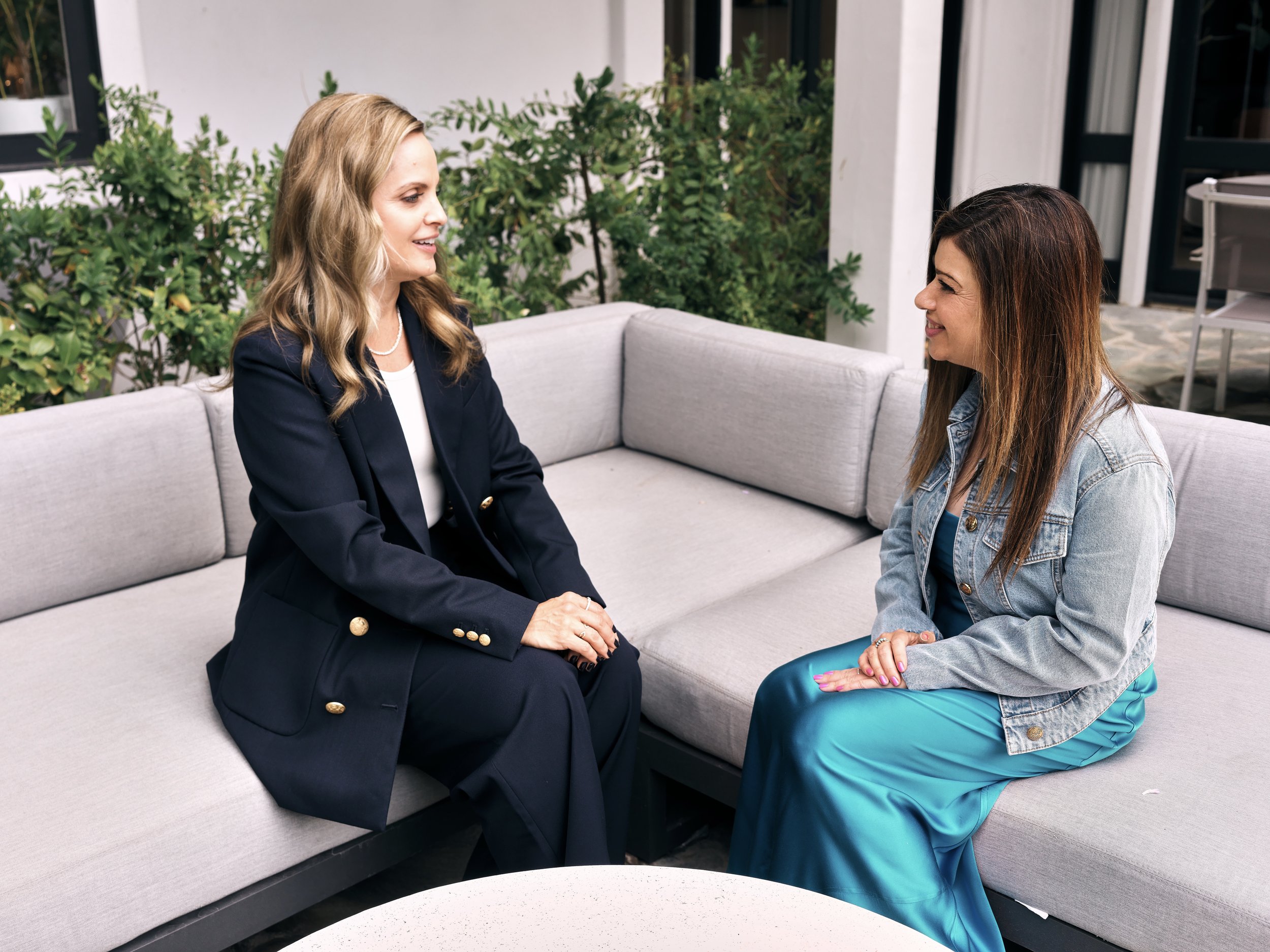
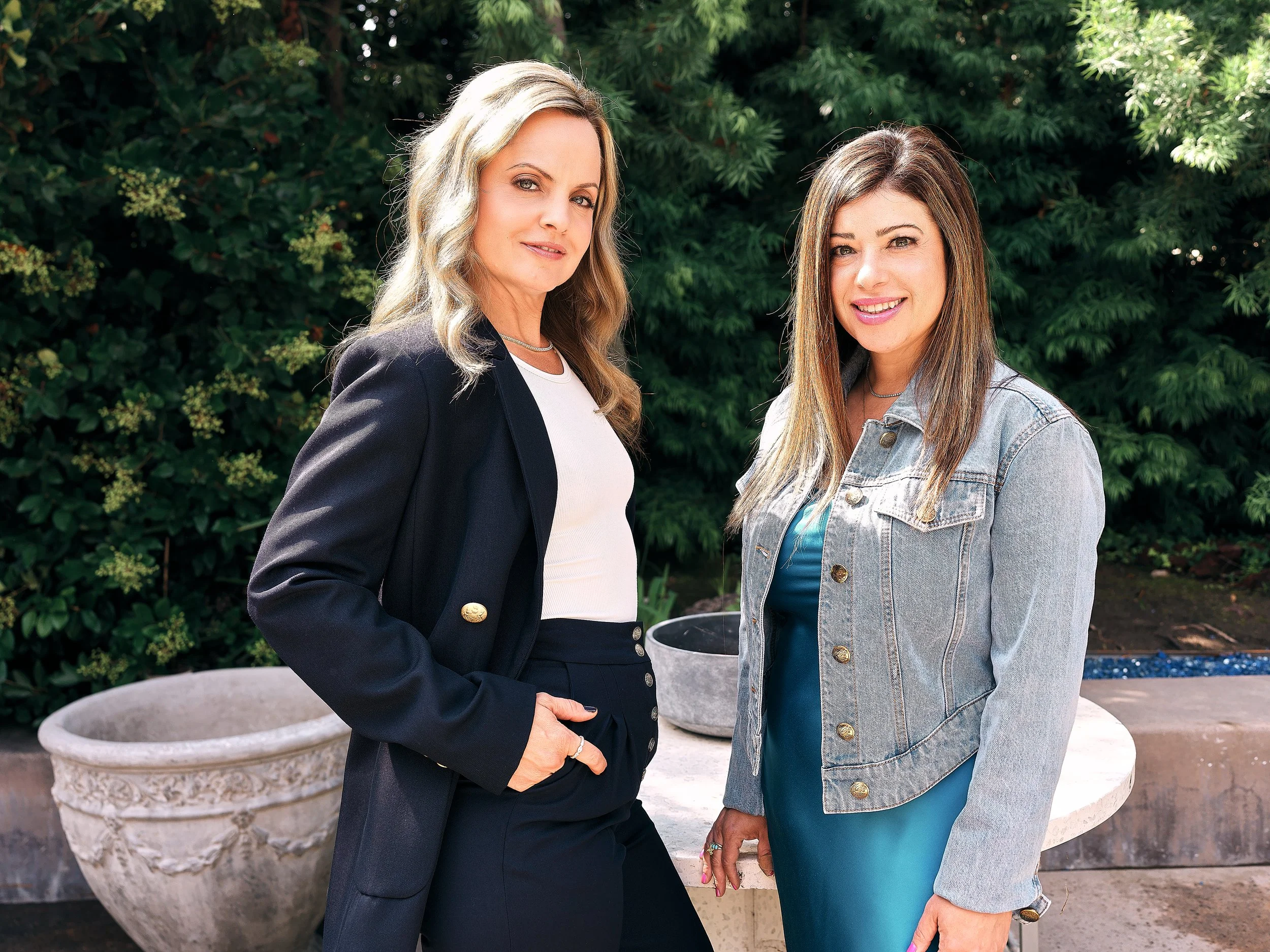
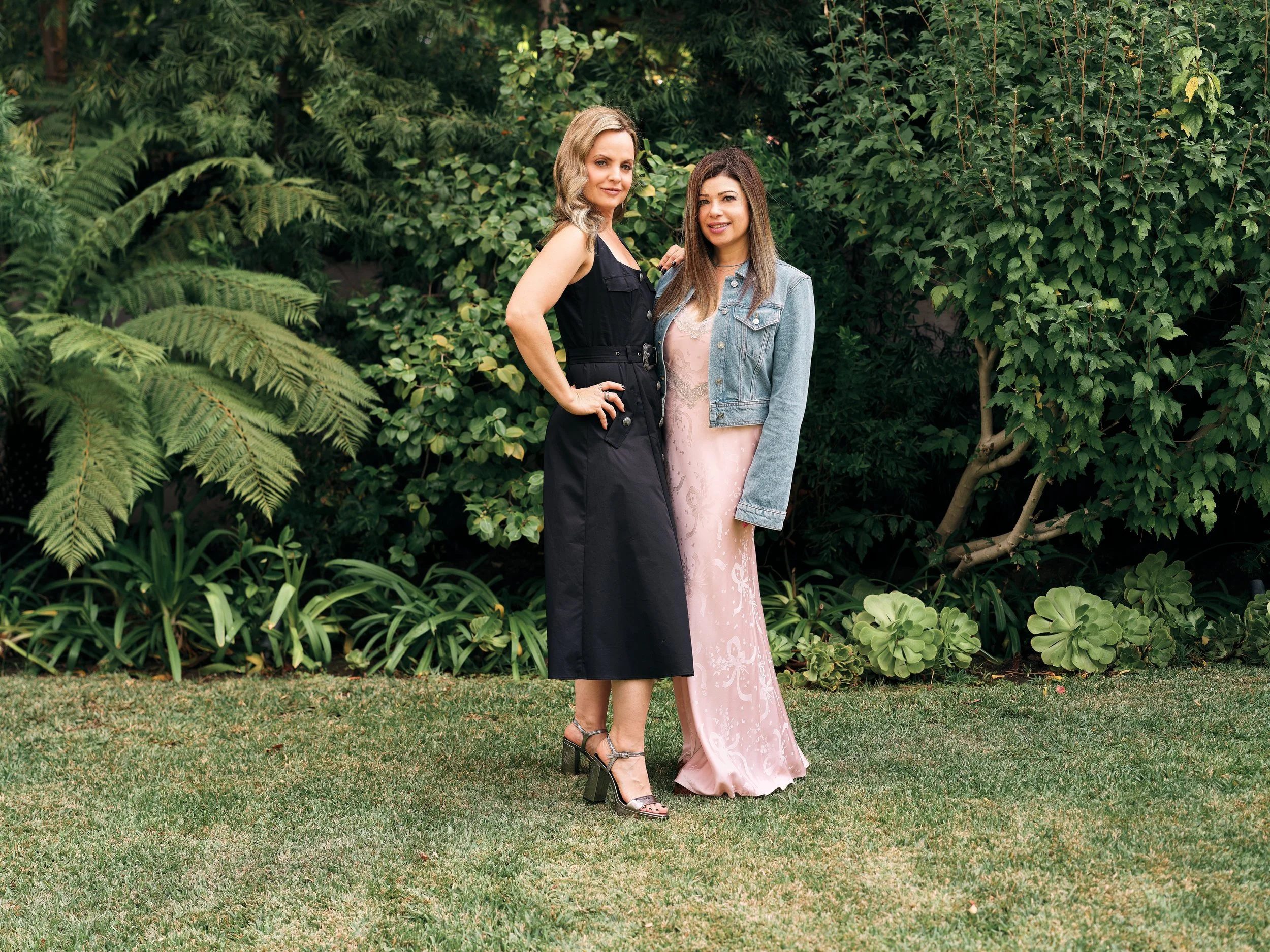
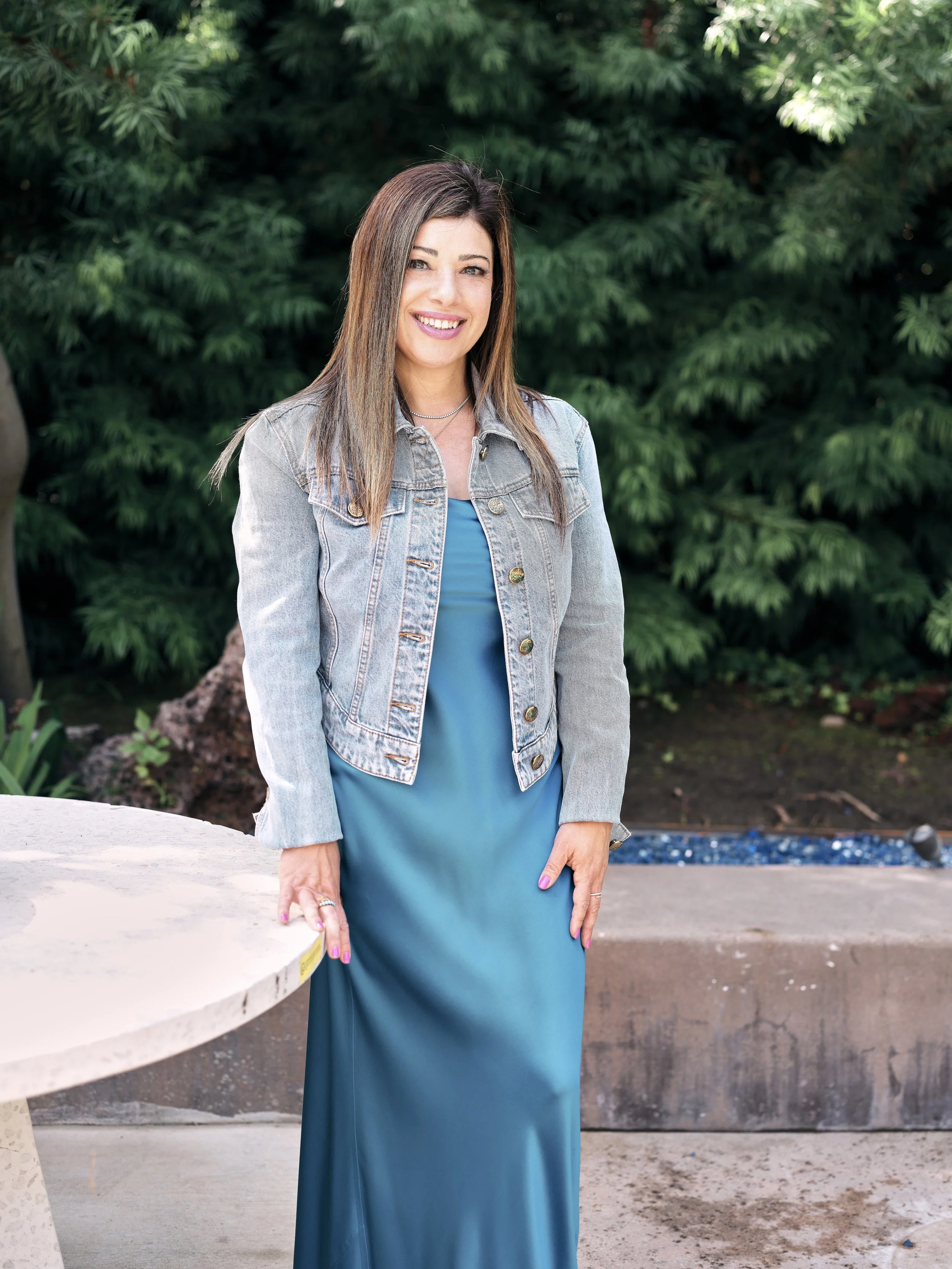
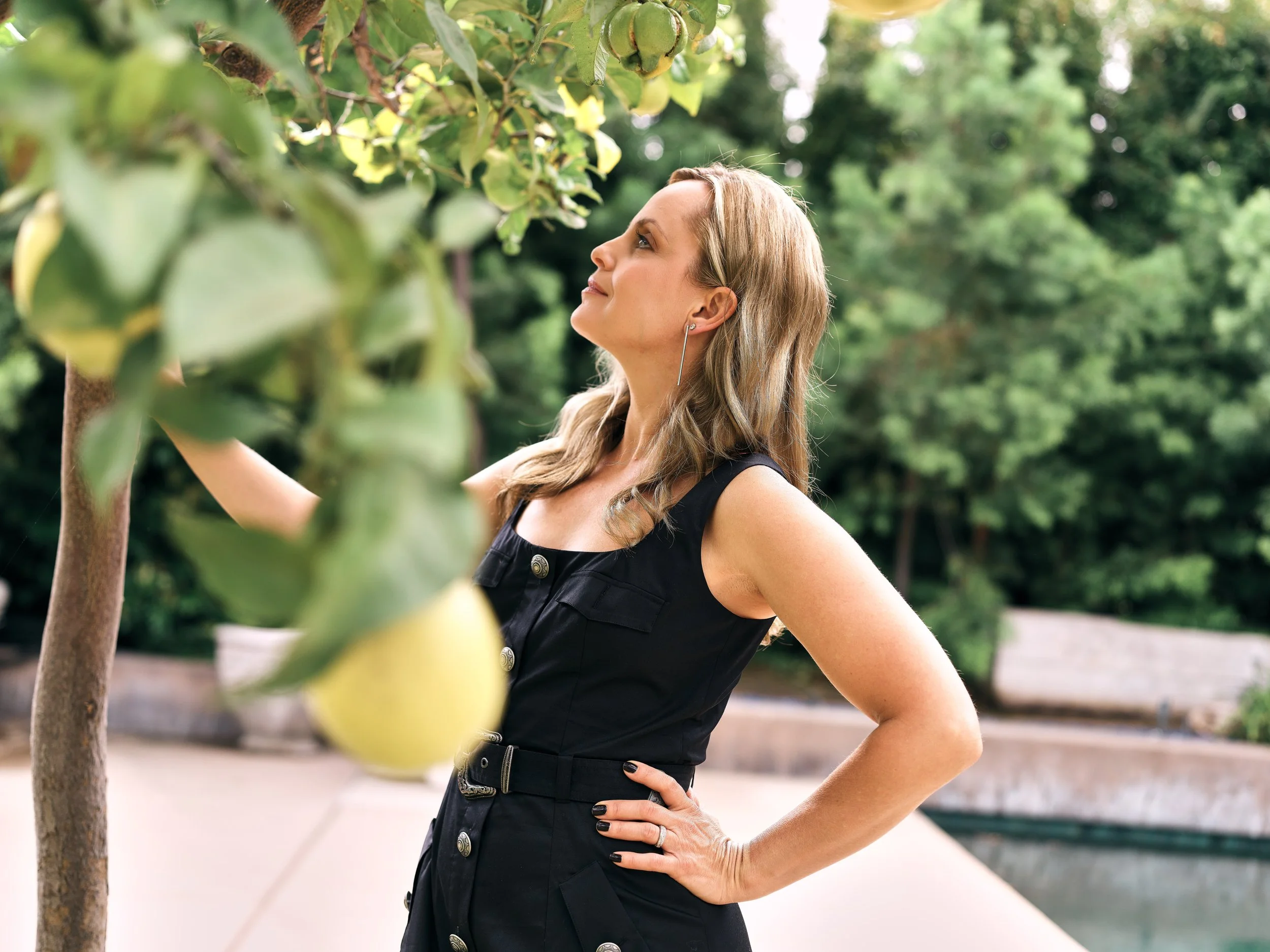
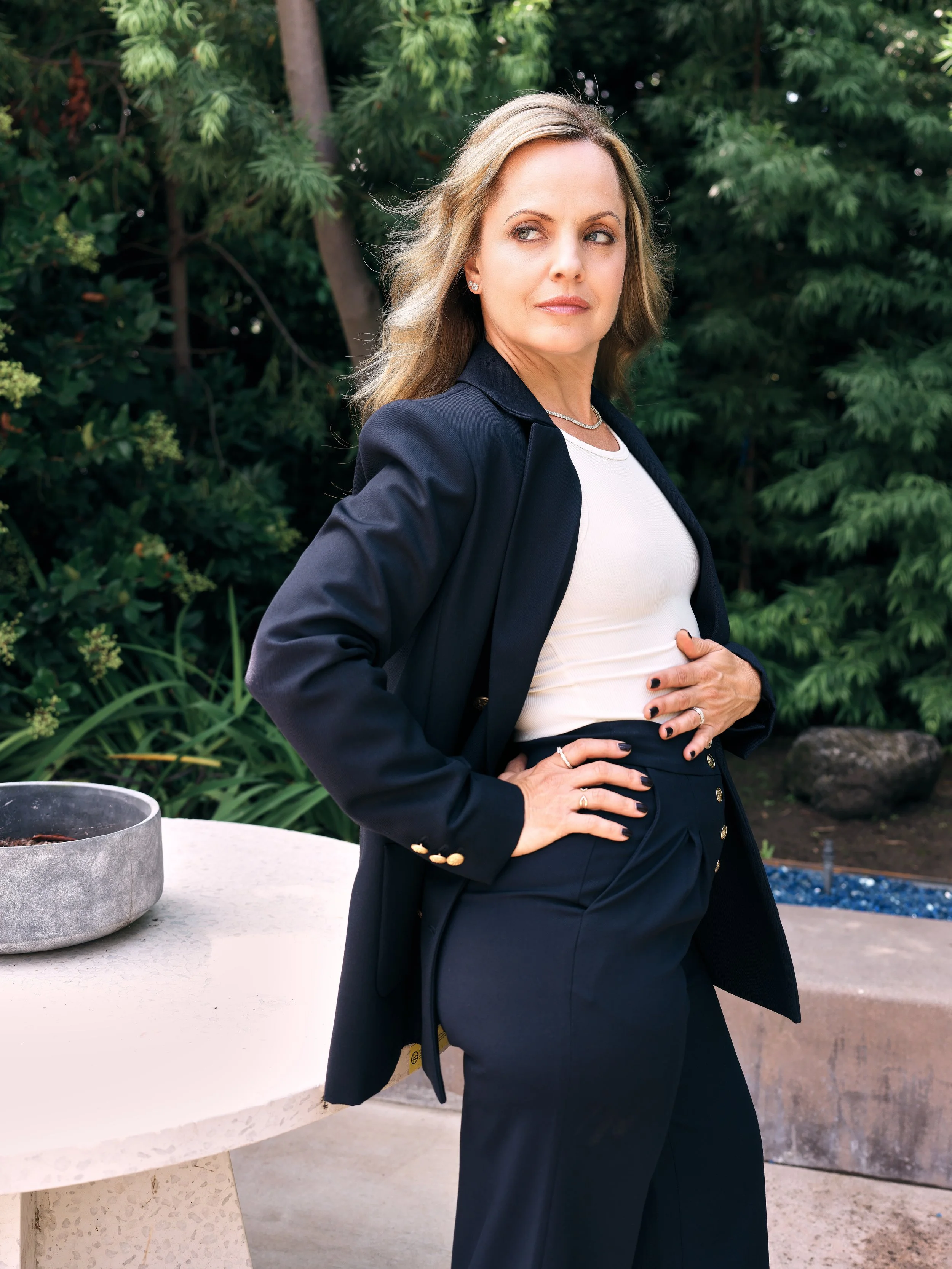
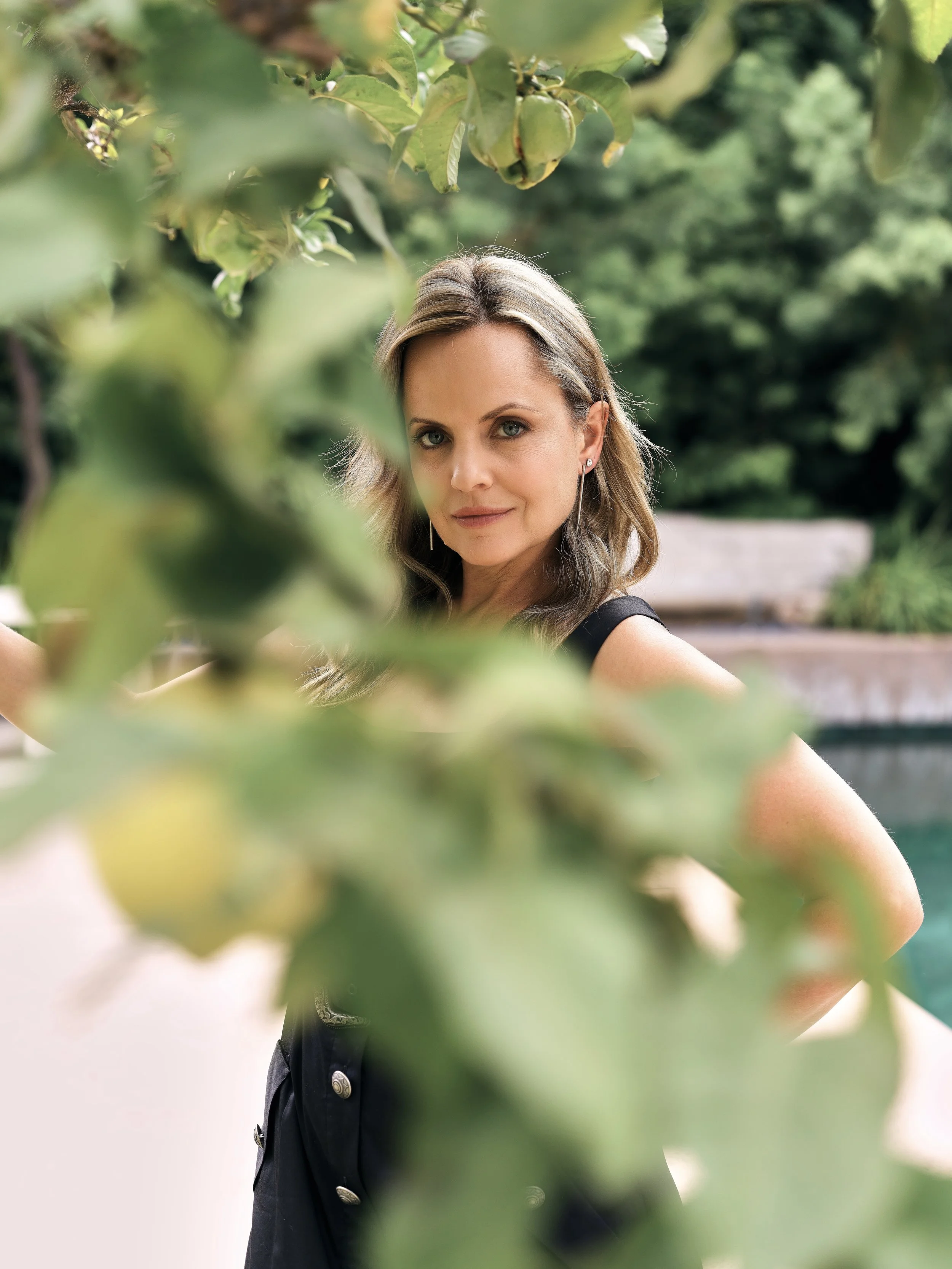
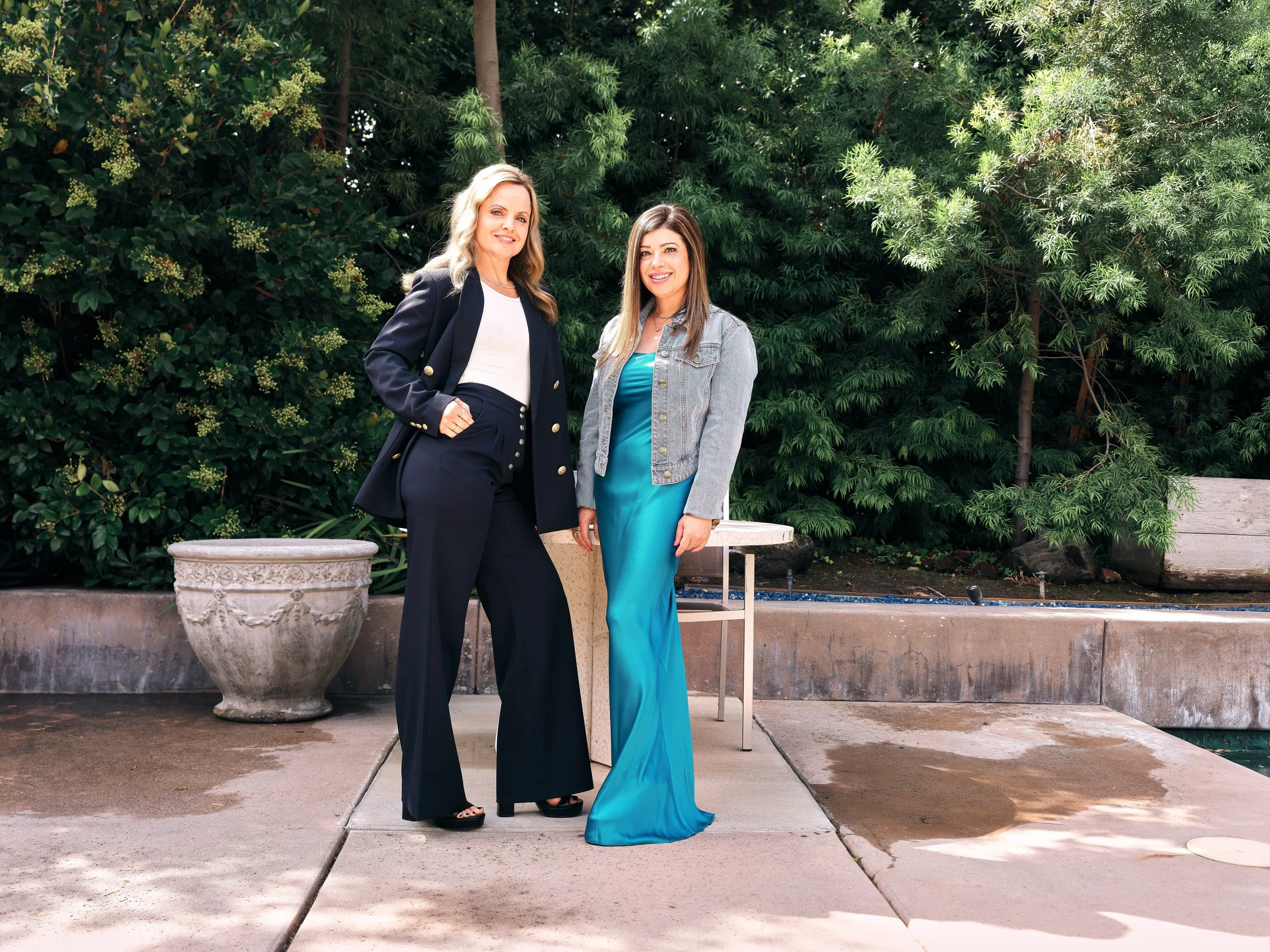
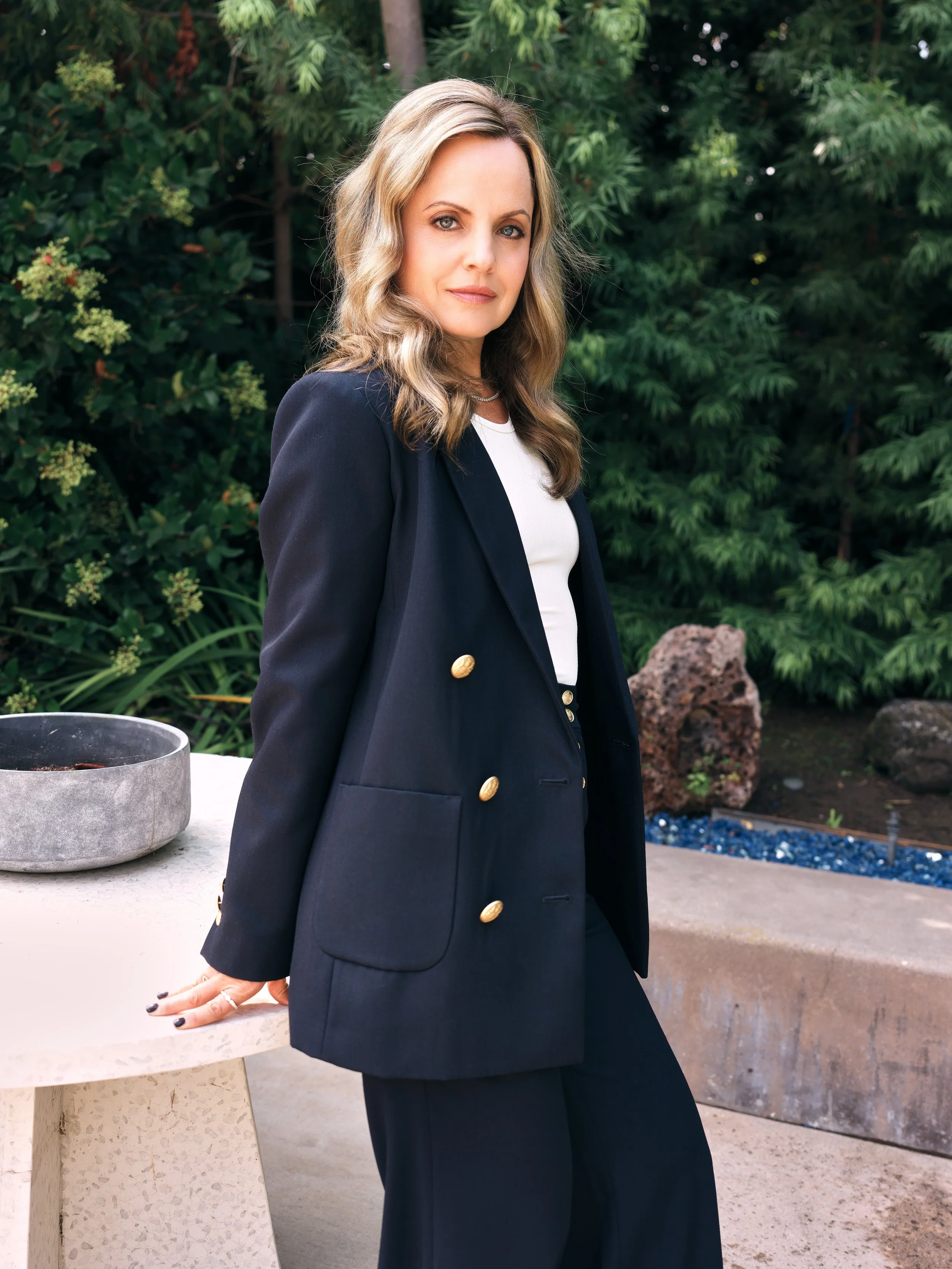
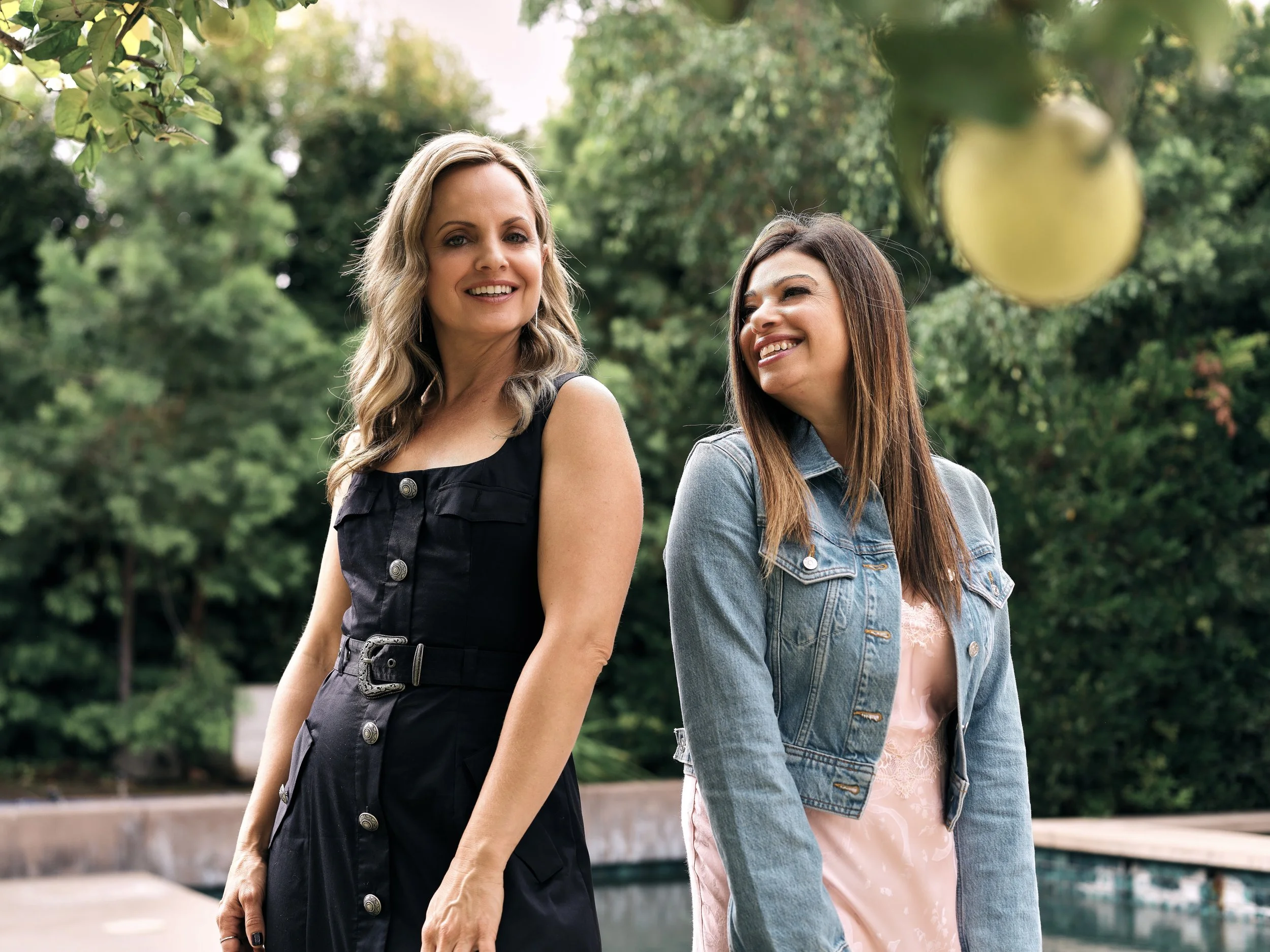
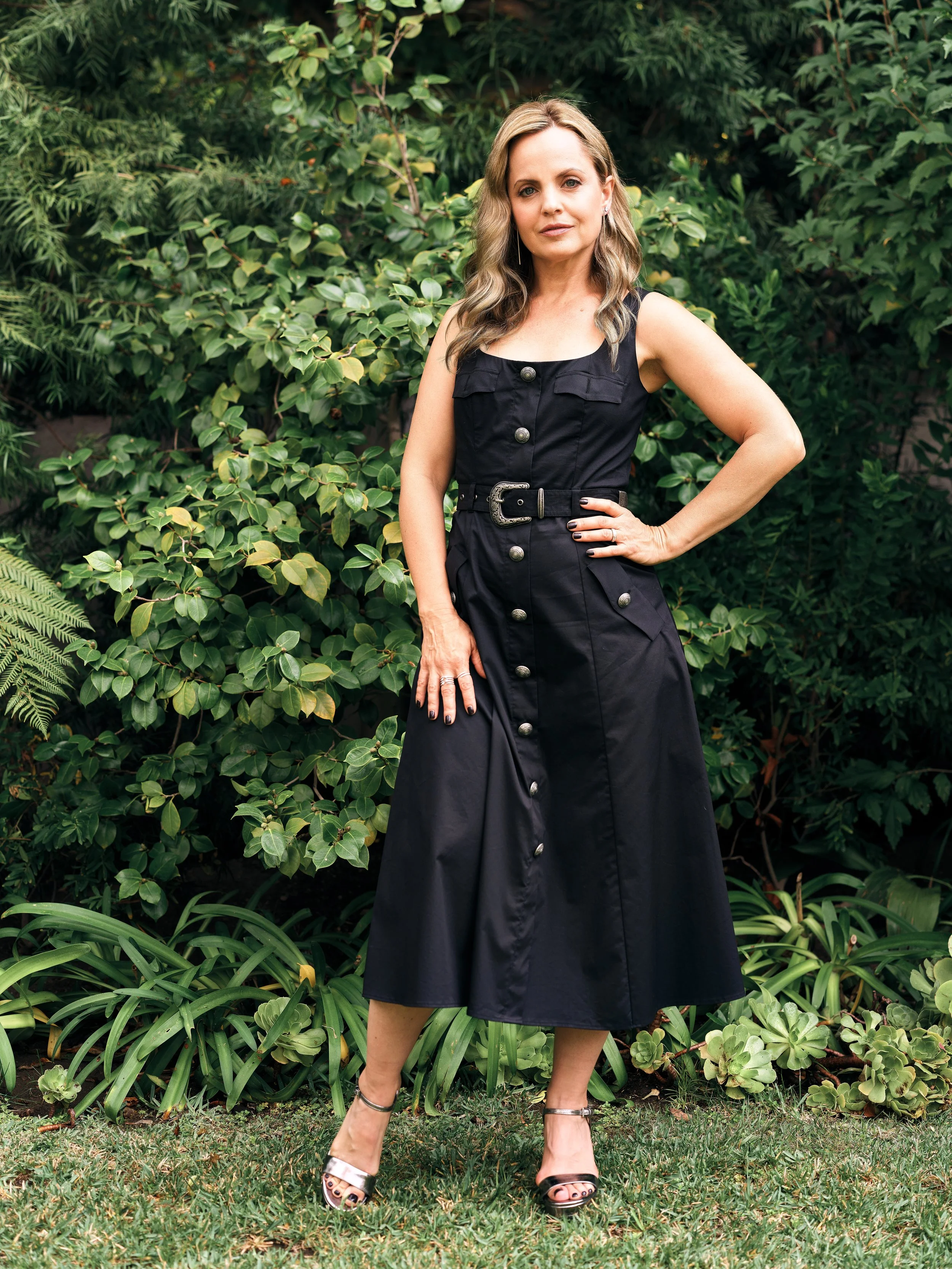
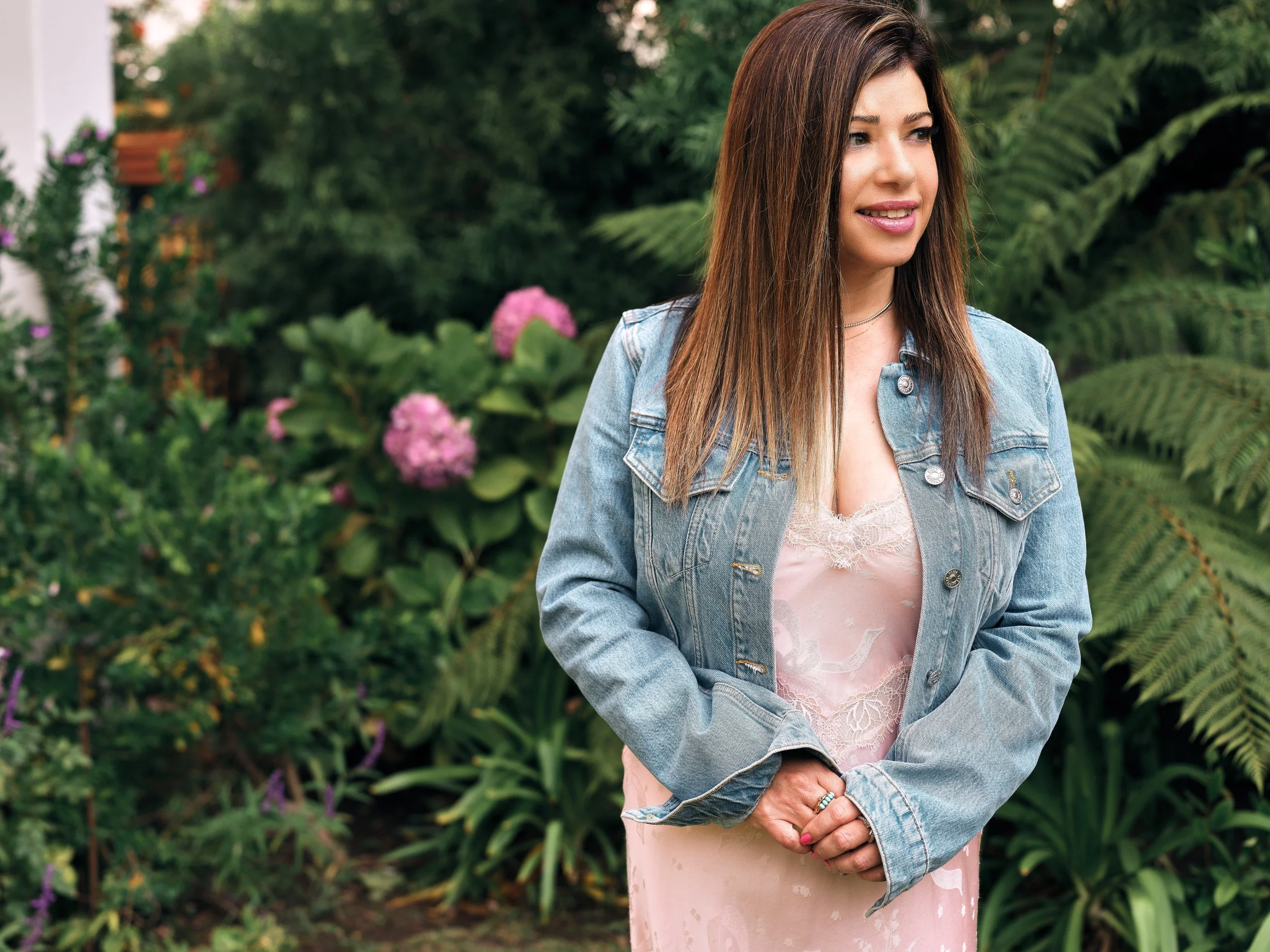
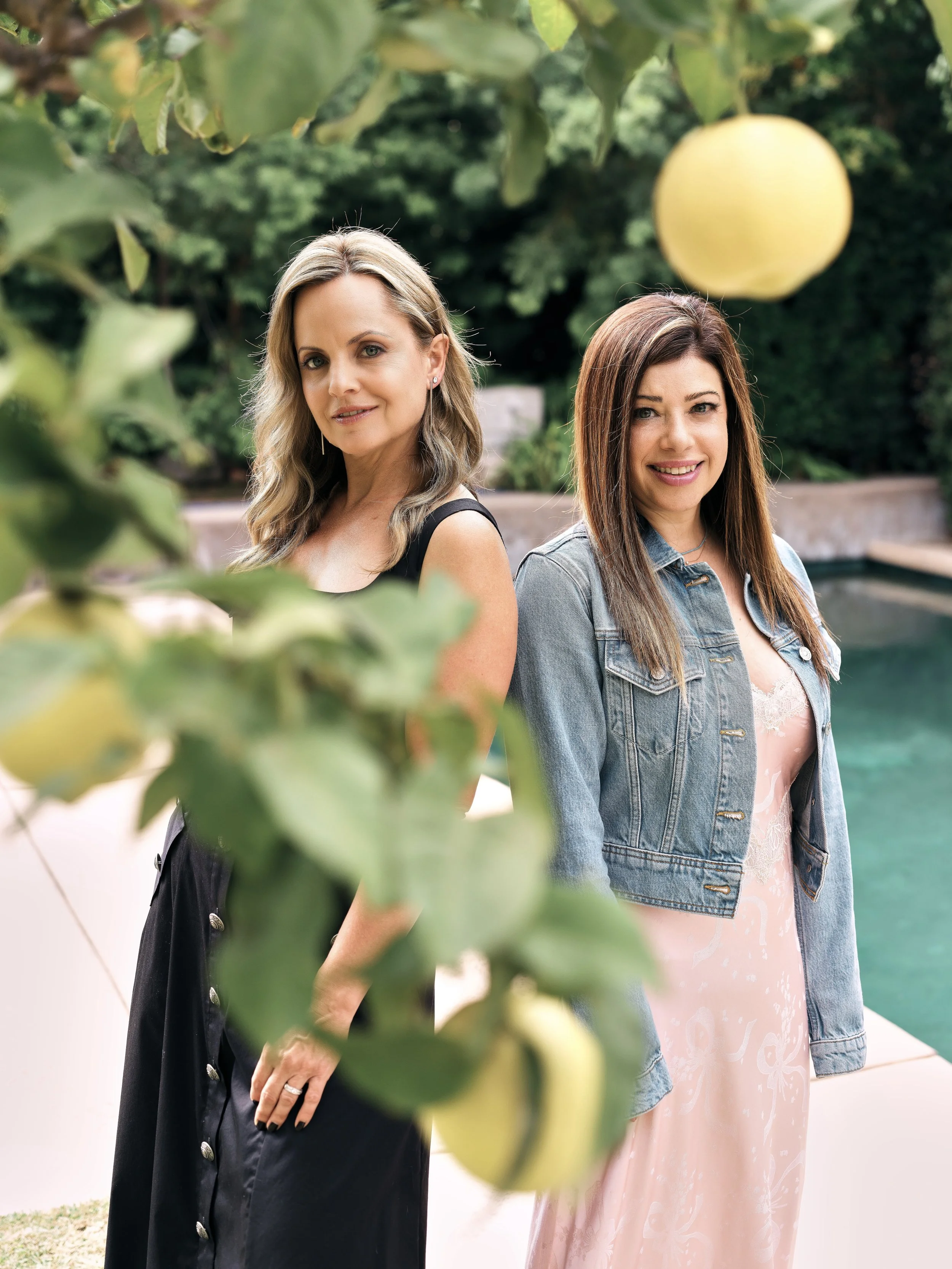
Shop their style // Look One: Mena’s navy blazer and pants are Sezane paired with a Sydney Los Angeles tank top, Massimo Dutti shoes, and Melinda Maria jewelry. Nola’s turquoise dress is by Alejandra Alonso Roja styled with a Zimmerman denim jacket, Chloe shoes, and Graziela Gems & vintage jewelry. Look Two: Mena’s black dress is by L’Agence with Rachel Katz earrings, an Effy ring, and Massimo Dutti shoes. Nola wore a Paige denim jacket with a pink Love Shack Fancy dress, Chloe shoes, and Graziela Gems & vintage jewelry.
Make-up for Mena & Nola by Jane Cohen. All styling by Nola Singer.