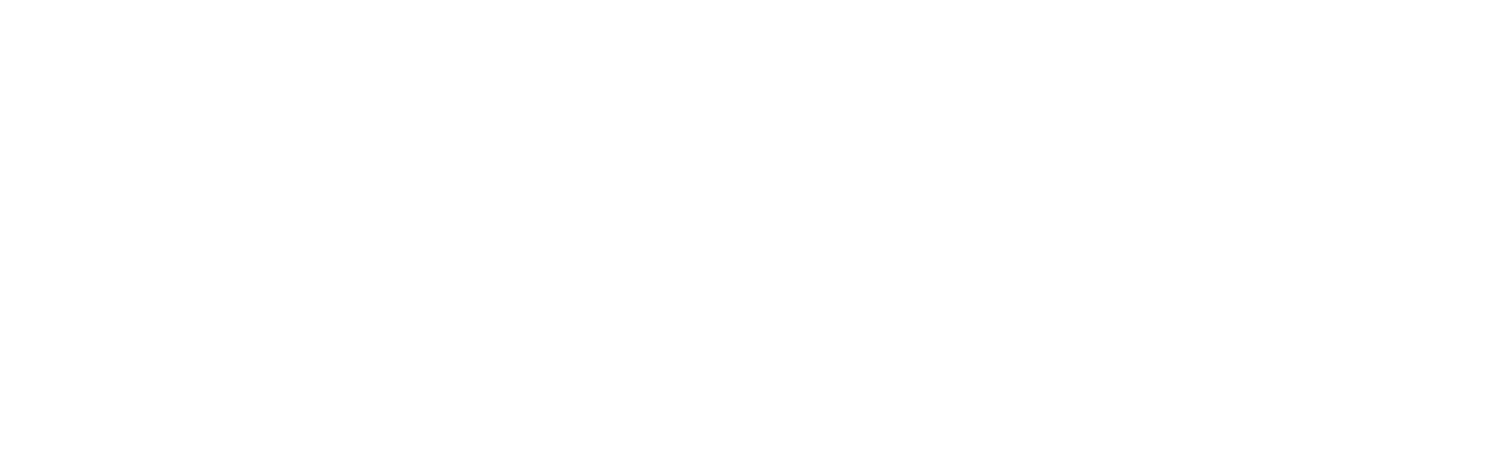
In Conversation: Jennifer Pastiloff & Emily Rapp Black
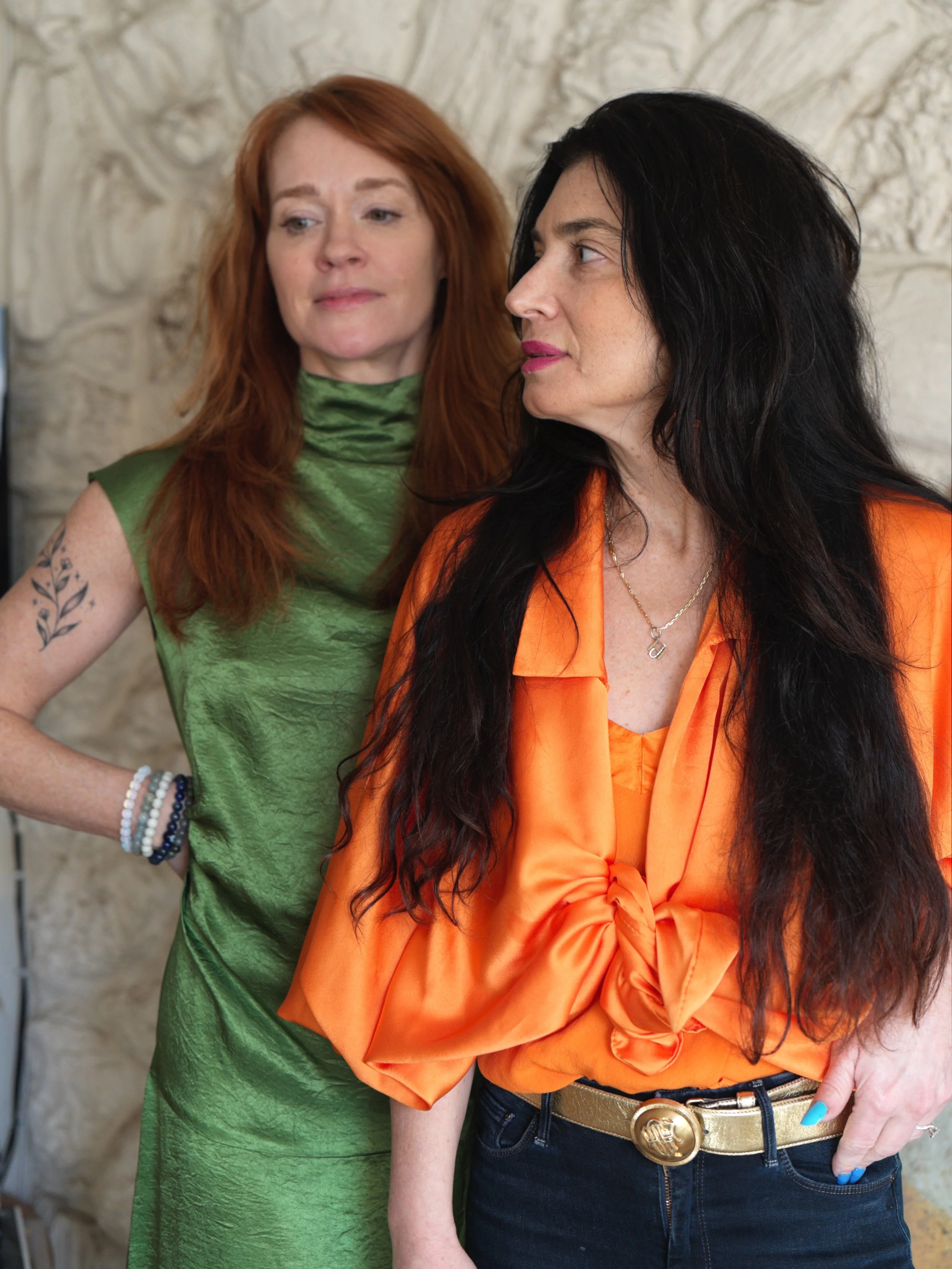
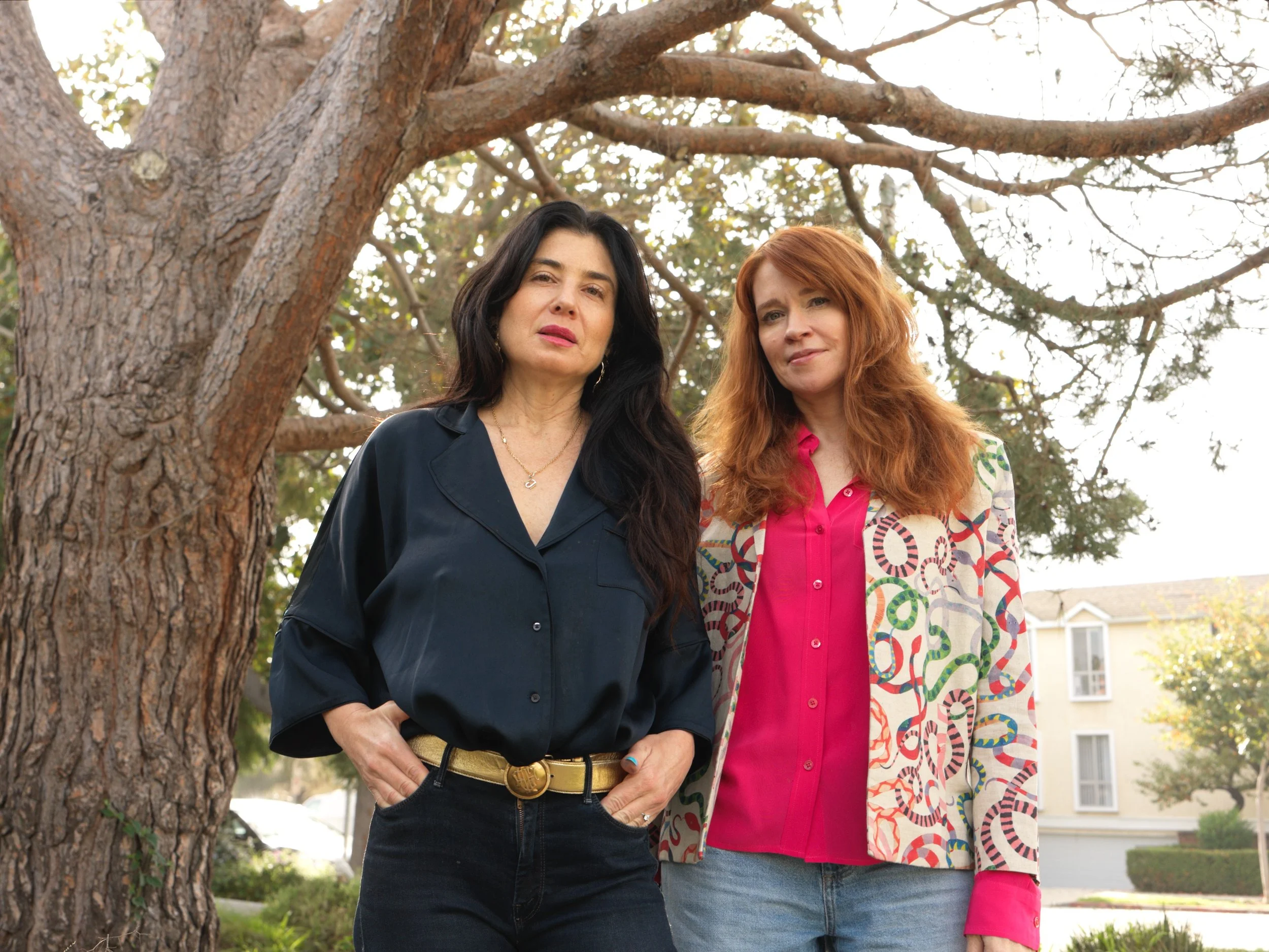
Photography by The Retaility & Henry Czerny
By Lindzi Scharf
I’m not supposed to be part of this conversation with authors Jennifer Pastiloff and Emily Rapp Black.
And yet somehow here I am doing the thing I hate most about modern profiles — I’m including myself alongside my subjects.
But it’s not my fault. It’s Jennifer’s. Which should come as little surprise to anyone who knows Jen and her work. The author doesn’t play by anyone else’s rules. And most certainly, not mine.
So, whether I like it or not, I’m inserting myself into the longtime friends’ story — an act I rarely do here on The Retaility. (I created this aspirational lifestyle platform to focus on other people telling their stories — rooted in the belief that shared experiences and conversations bring us all closer.)
The fact that Jen keeps breaking the fourth wall and inviting me into her conversation with Emily ultimately speaks to what these two do best through their writing workshops... which is to create community, connect deeply, and explore humanity, with the understanding that no one is more important than the other.
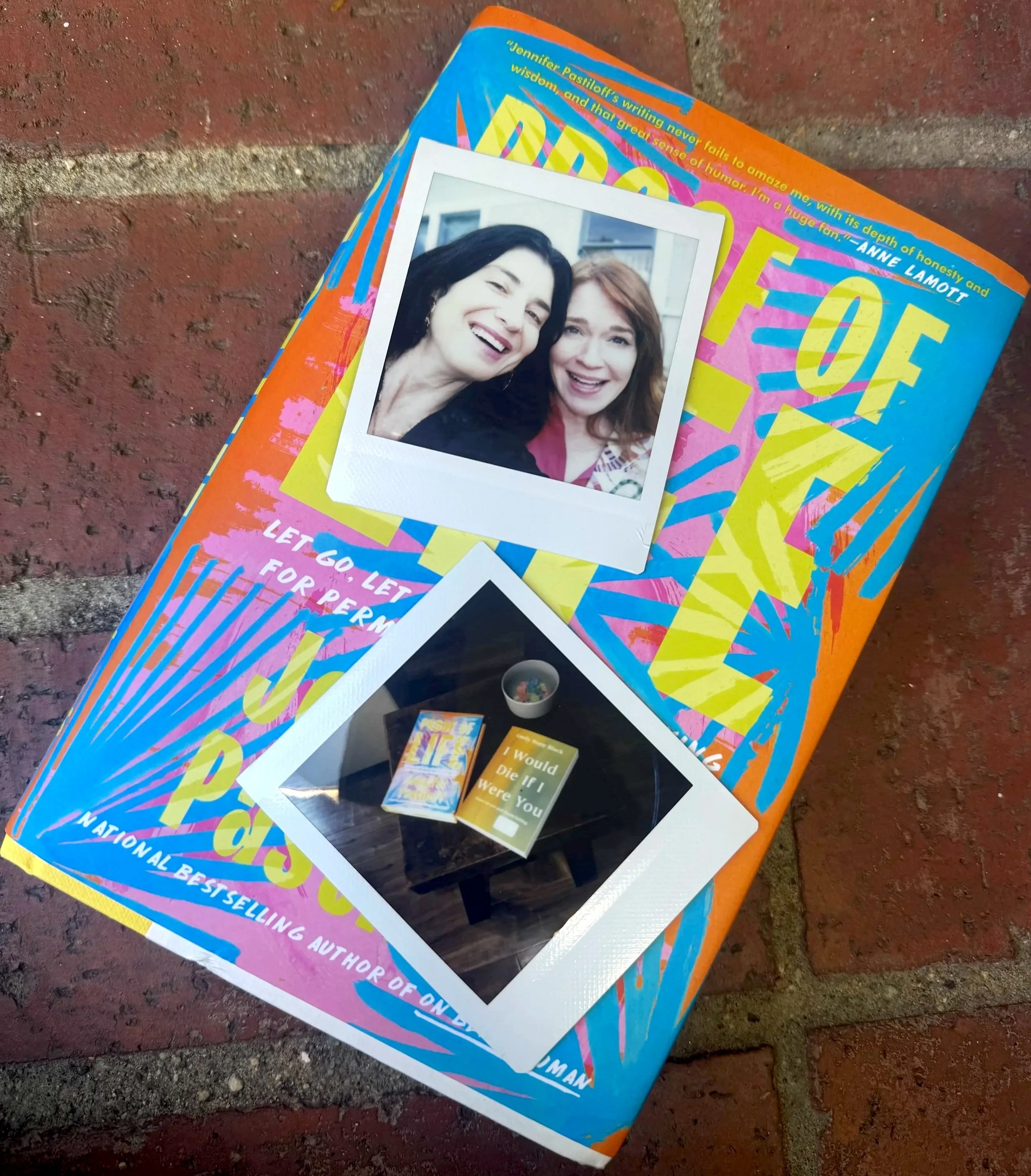
For those previously unfamiliar, Jen is the author of “On Being Human” and “Proof of Life.” She’s also a poet and artist who leads workshops and retreats in Italy and her home base of Ojai.
When I approached Jen about doing an “In Conversation” feature with a friend, she immediately suggested Emily. In part because the New York Times-bestselling author recently released her fifth book, “I Would Die If I Were You.” But also because Emily and I share a piece of delicate history.
We're both part of the worst club there is. We've each lost a child. For context, I lost my daughter, Evan, to a rare mitochondrial disease in 2022; Emily lost her son, Ronan, to Tay-Sachs disease in 2013. Her second memoir, “The Still Point of the Turning World,” follows her son’s diagnosis.
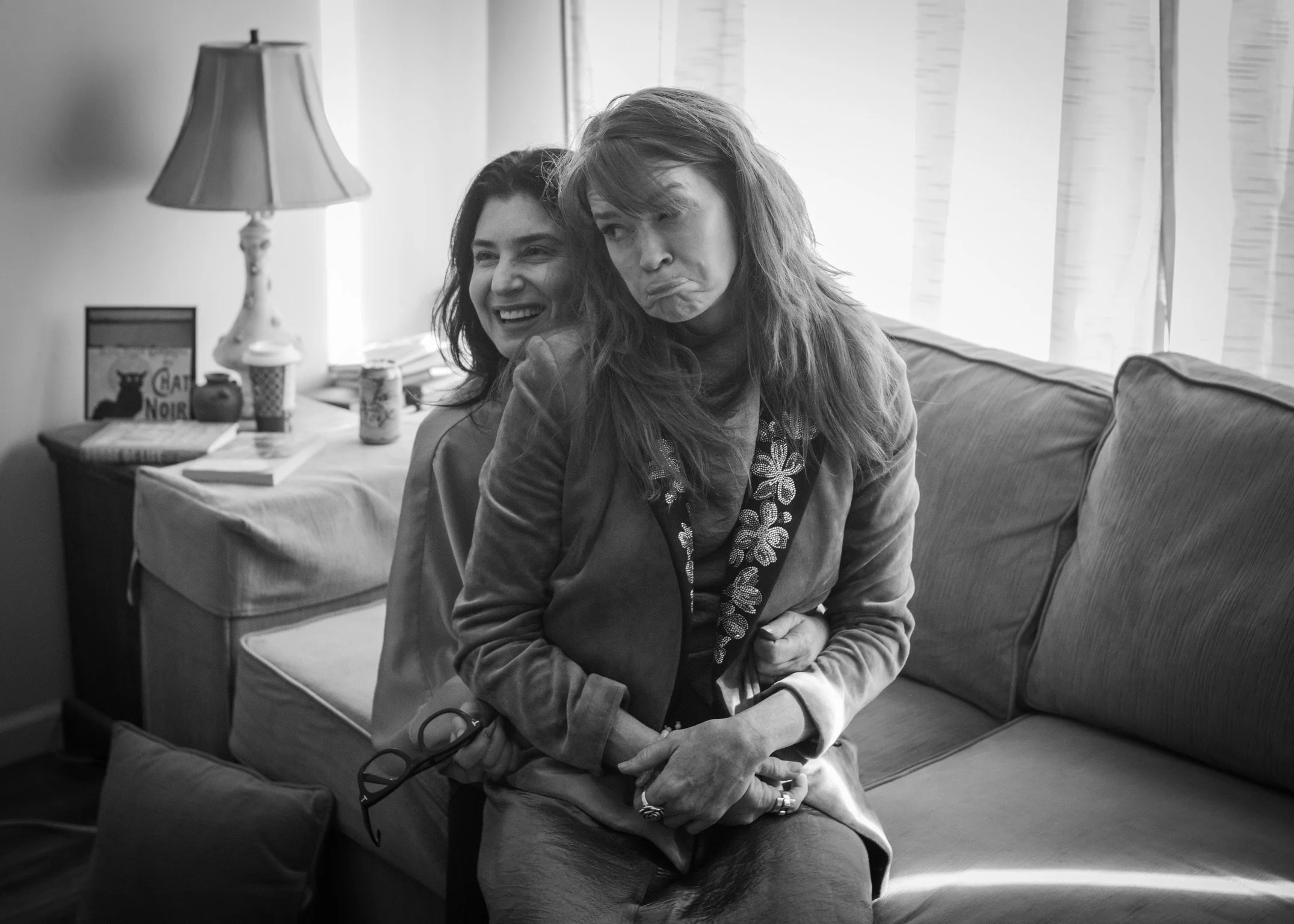
“Lindzi and I met at the Grieftastic by Meghan Riordan Jarvis,” Jen explains to Emily, seated on a couch in the Los Angeles apartment she shares with her ex-husband. (She splits time between her old stomping ground and her Ojai home, where she’s based.) “The tagline is, ‘It's like your eighth-grade book fair but sadder.’ And they gave out swag bags, and on the bag it said, ‘Sad Sack.’”
“I love that,” Emily laughs. “Oh my god, that's cute.” Her sense of humor is on full display — with goofy voices and wise nuggets of wisdom shared throughout the day.
Emily kicked off her writing career with 2007’s “Poster Child,” which explores her life as an amputee as a result of a congenital birth defect that resulted in the amputation of her left leg. She was selected as the face of the March of Dimes when she was just six years old. Emily is also a creative writing professor at the University of California, Riverside, in addition to co-founding the virtual writing community “Craft School.”
“The question I get asked the most [over the] last 25 years of being a teacher of writing is, ‘Am I good?’ Not, is my writing good? Am I good? I say, ‘Yes. You are innately good. Your writing and you are not the same thing.’”
The women met many moons ago when Jen was a yoga teacher who’d yet to pursue writing. She was by Emily’s side for Ronan’s diagnosis. The two lost touch for some time, but recently reconnected.
“I’m super grateful we’re here in this apartment,” Jen tells Emily between sips of non-alcoholic wine. (Jen’s partner, Henry Czerny, is also in the distance snapping black-and-white photos of his muse, many of which can be seen below.) “It brings back memories [being here with you]. And the synchronicity of this? There are shitty clubs, and when you find someone else that’s a member, and they happen to be like-hearted—I don't like like-minded but like-hearted—it's a special thing.”
The universal conversation that follows is for anyone interested in exploring creativity in any modality, anyone who loves to write, and anyone who is previously unfamiliar with Emily and Jen’s journeys. It’s also filled with beautiful suggestions and prompts for channeling your grief into art.
“To Evan and Ronan,” Jen says, toasting Emily with a glass of nonalcoholic wine. She pauses, then looks at me. I’m standing off-camera recording this conversation for audio and video purposes. “Wait, wait, wait,” she nudges. “No, you gotta be [in it, Lindzi].”
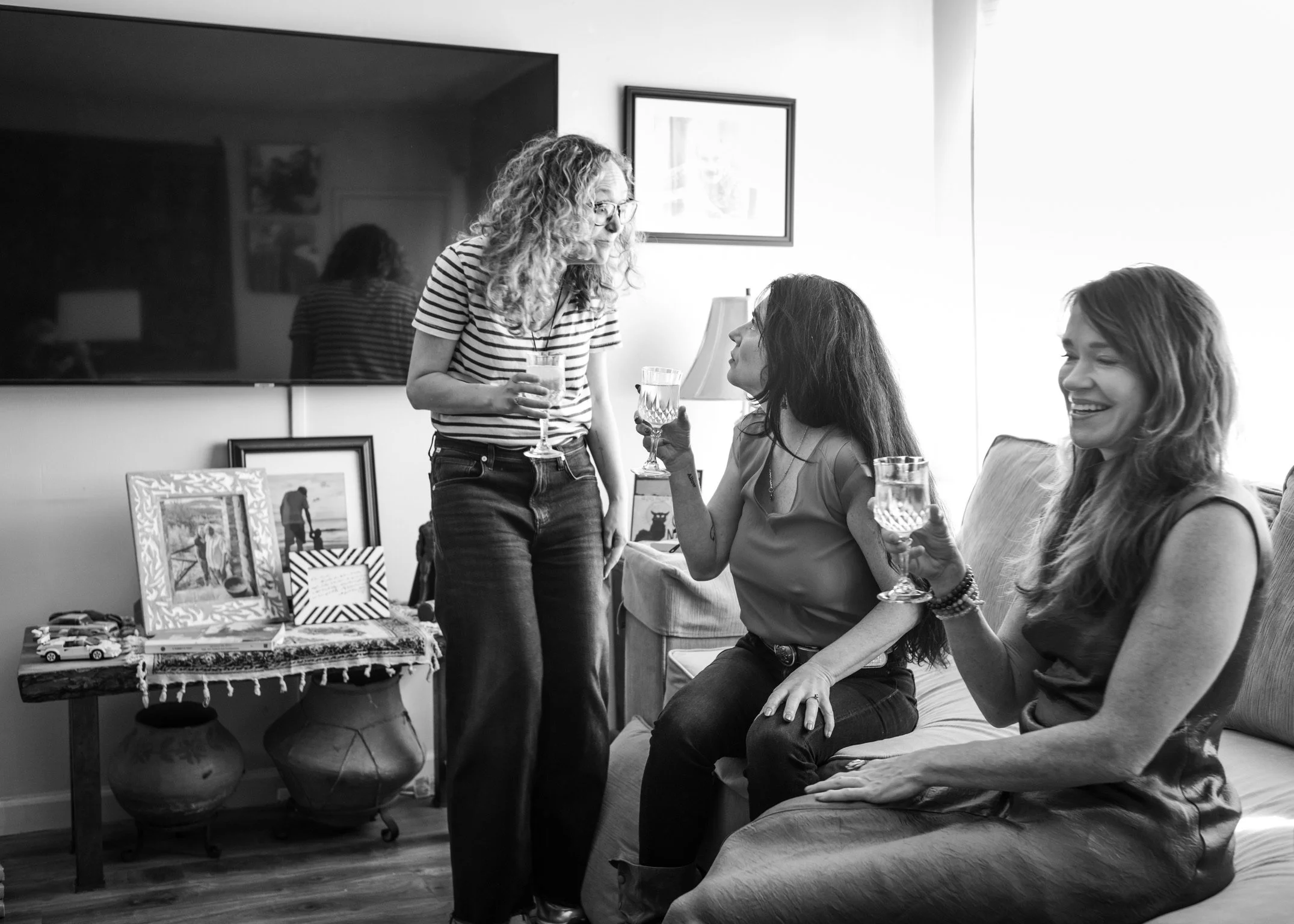
“That is beautiful, Jen,” I say, though reluctant to join the duo. “Thank you.”
“When is Evan’s birthday?” she asks.
“July 31st,” I tell her.
“And Ronan was?”
“March 24th,” Emily says.
“Well, cheers to being here together,” I tell them. “I’m so grateful you guys are doing this.”
“What are we doing here?” Emily asks.
“I feel like we’re about to do an Ayahuasca journey,” Jen jokes. “Even though I’ve never done that.”
”You should,” Emily says. “It’s awesome.”
“Every second of every day, I’m on an Ayahuasca journey,” Henry jokes, between snapping photos.
We all laugh, and the afternoon gets underway. Because Jennifer and Emily are both memoirists, they've written an oral history. And I'm hanging on every word. You will, too. Keep reading...
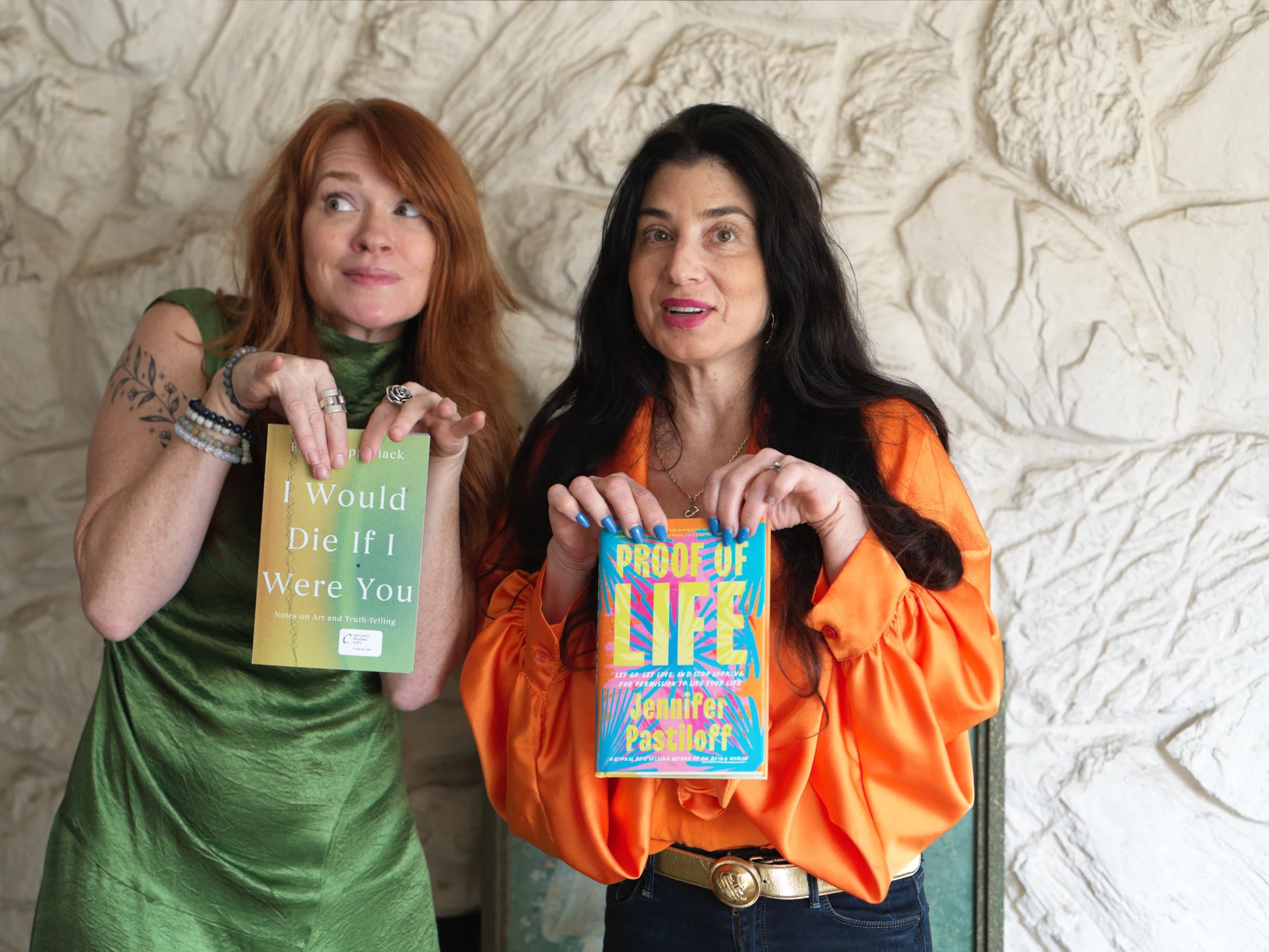
JENNIFER PASTILOFF: This is like a reunion. I'm grateful to my friend, [whom] I love so much [and] met on Instagram... Rachel Goodwin is our [kind of] people, and then she brought the little fairy to Grieftastic. When [Lindzi] asked me about [doing] this [conversation] right away [I thought of you]. The synchronicities are chef's kiss. [Do you want to explain how you and I first met?]
EMILY RAPP BLACK: I was in Jen's yoga class at the Equinox of Santa Monica. And we were going to go into some horrible overhead move. It was a handstand. And I was like, ‘Wait, I have an artificial leg,’ and all of a sudden she grabs my crotch.
JP: I knew you were going to say I grabbed your vagina. I didn’t.
ERB: She just totally grabbed my body without consent.
JP: Oh my god, okay, she's trying to be funny.
ERB: She grabbed me, and I was like, ‘Oh, wow, actually now I'm in a handstand.’ It actually worked, but it was just funny. I was like, ‘No, no, it's okay. I'm trying to do this.’ And she was like, ‘Whatevs.’ I think because you couldn't hear me, and I was mumbling.
JP: Well, my hearing has gotten progressively worse. But I was a very new yoga teacher, and I had never had someone with a prosthetic leg or a prosthetic limb or missing a limb or anything. I remember thinking to myself, ‘Oh, I didn't get in my head about it.’
ERB: No, I was fine. I was like, ‘Great.’ I was glad, actually, that you didn’t treat me with kid gloves.
JP: I just got thrown in there, but I didn't think twice about it. I just grabbed what had to be your prosthetic.
ERB: Yeah, you just grabbed it and put it up. Because I was kicking up. You were just like, ‘Let me take you all the way.’
JP: But then [you] changed it to the vagina. I’m all good with that.
{They laugh.}
JP: Because, as I said, about three years ago, I started making art, and I don't know how to draw. I grew up [thinking], ‘I'm not an artist,’ as we do, right? Somehow, I just draw naked ladies. Every time my stepdad comes over, without fail… I mean, my house is covered. He [says], every time, ‘You sure you're not gay?’
ERB: Oh my god. Is that what he says?
JP: I mean, he's trying to be funny but with a wink. But I probably kind of am. You would wonder the same. It’s just non-stop boobs and butts all over. He's joking, but also most of my friends are lesbians, and then there’s naked women everywhere, so this tracks. He's saying it with a big wink, but he's like, ‘All you paint are naked women.’
ERB: Why not?
JP: I don't want to paint naked men.
ERB: Yeah, no one needs that.
JP: Yeah, so we did meet in a yoga class. Emily was… or is? I actually don't know because [this is a] reunion. [But she used to be] a gym rat.
ERB: I don’t exercise around people anymore because I don't like people. Just kidding. I'm a Peloton girl. After the pandemic, I was like, ‘I don’t want to sweat next to anyone ever.’ So I do it on my own. I have a Peloton.
JP: I used to be an exercise bulimic. Never a… Vomiting makes me want to vomit. But I used to be like that. And now it's been almost three years since I've moved my body. Am I proud? No. But I was teaching yoga at Equinox, and that's how we met. And then…
ERB: I was also an exercise bulimic, for sure.
JP: Yes. And so we had that. We bonded. We trauma-bonded.
ERB: But Emily was not the typical, or at least in my mind, clientele of this high-end gym.
JP: As in broke.
ERB: We were the two broke girls.
JP: That’s not what I meant.
ERB: That was true, though.
JP: I meant because… I went to NYU, so I have this snobby attitude. Like, ‘No one here reads.’ And you were so intelligent. When I found out who you are, I was like, ‘What?!’ You were an anomaly at the gym.
ERB: Yeah, I did read. It's true.
JP: Well, and write and all of the things, you know.
ERB: I definitely didn't fit in in conversation at that gym.
JP: Therefore, I was not talking about the socioeconomic [element]. But yeah, sure, that. Then I was in complete awe of you. Before I accidentally dropped out of college, I thought I was going to be a poet. So I was intimidated [by you] but also not because you're dorky and…
ERB: Yeah, and also [I’m] not a poet.
JP: One of my favorite things about you is [that] you are so goofy — so I didn't feel intimidated in the way that I couldn't come closer.
ERB: I thought you just liked my butt.
JP: Yeah. I loved your butt. I mean, but that's a duh. But then the writing part.
ERB: No, we connected over that. I mean, I think that actually goes to what you were saying about art. And actually, my new book is about this.
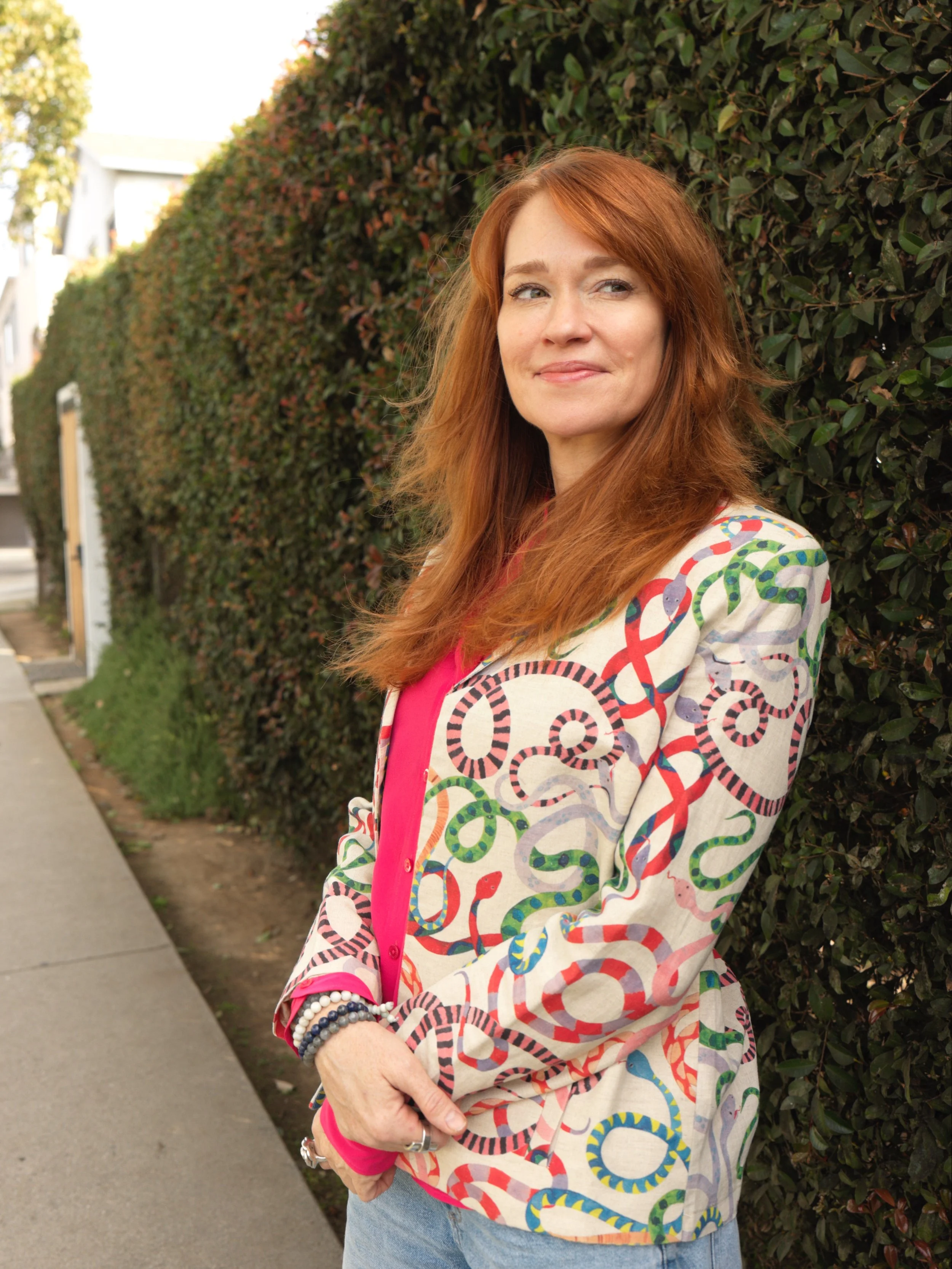
“I WOULD DIE IF I WERE YOU”
JP: What’s the name of your new book?
ERB: It’s called ‘I Would Die If I Were You.’
JP: That’s so rude. No one said that to you?
ERB: Oh, so many people. If I had a penny or a nickel, because now pennies are gone, for every time someone said that to me, I would have had a happier [life].
JP: Fuck, and then you wouldn't have been, like, so-called broke.
ERB: Probably. I'd be rich if I could get those pennies back, man. No, but I think in the book I talk about… We were told as kids, ‘Don't create unless... especially in this culture, we monetize everything we make.’ Unless you're good. Everyone is a born storyteller, whether you're doing that through poetry, non-fiction, fiction, visual art, music, or healing modalities. Everyone is a storyteller. The body tells a story. You have one unique story you can tell. And it doesn't matter if you become famous. It doesn't matter. What matters is that it fuels some kind of interior life — that in your hardest moments will rise up for you. So when my son was diagnosed with a terminal illness, I was so grateful for my interior life because that is where I lived, almost exclusively, to bear it. So it was pulling down all the things I'd read in college and in divinity school and all the other lives. I had all of these stories inside.
JP: Can you speak to that quote? [Rainer Maria] Rilke? Love and death. I’ve been obsessing about it.
ERB: I’ve always been a Rilke addict.
JP: I feel like that quote ties in to what you’re talking about.
ERB: I don’t know if this is exactly the wording, but it’s [something] like, ‘Love and death are the greatest gifts given to us. And mostly they are passed on unopened.’ Yeah. And I think that's very true. Anyone who's had a loss of any kind, which is all of us at some point… Especially for a person, you know that the level or the depth of your grief isn't equivalent to your love. But they come hand in hand. Like, the deepest grief reflects the deepest love. So even though we can be sad about people we don't know dying… but if someone we know — our child, our partner, or parents — the grief that comes up is a reflection of whatever that kind of relationship or love experience was. And that's why it's so hard, because it’s level with love. So the risk of love is to experience loss. You cannot have one great love without the risk of great loss. They don’t happen on their own.
JP: My whole life, I thought—and it was unconscious but intimacy… And it’s ironic given what I do for a living, which is very hard to even say… But I somehow created this thing where people would get really vulnerable and intimate. And I was masterful at it, but within my [own life]… Hell no. I couldn't cry until July of 2022. So intimacy scared me more than anything. I abhorred it. I was terrified of it. And it's sort of like the cobbler [whose kids have no shoes]. Like, of course, this is what I do for a living. But I thought, which is why I was able to stay in a marriage where I never had to be intimate, you know, and I got something from that. But it's like, I can't get hurt that way. If I don’t [reveal those pieces of myself]. Sure, you're thinking you can get through life unscathed? First of all, you can’t. But also you're missing out on the…
ERB: The highs, the lows?
JP: The beauty of love and all of that. The pain of it? Yes. But you don't get to have that without the other.
ERB: It sucks, but that’s how it is. That’s why that quote is so great because it's basically [saying] these are gifts. That the knowledge of your mortality, the knowledge of this idea that you know you will die, and you know it even if you ignore it… To embrace that is to live with more love and freedom. I mean, it's not easy to do. It's not like I go around being like, ‘Yeah, I’m going to die. Awesome.’ But I think I am very conscious of the fact that — in the end, it doesn't really matter. What matters is what you're doing right now, which is what all the yogis say… It's the message, right? It’s almost impossible to do except when you're in love and when you're in grief. You can't not be present in those places. You can’t. There’s no way around it.
JP: I've known you for so long… Even though it's been a few years. But I remember it so vividly. The email [you sent]. Because it's so hard. You can't call everyone with something like that. And you sent to a few of your good friends a [note that said], ‘I'm sorry for the group email, but…’ When you found out the diagnosis. And pretty immediately, you started doing this blog. … One of the things I hate—and I'm sure you hate this too; I know you do—is this stupid shit [people would say]. i.e., ‘I would die if I were you.’ Like, people say, ‘This is a gift.’ Maybe you can alchemize it and turn it into art. Or maybe years later—or whatever the time frame is—you can find a gift in it. Maybe. That narrative. But I do think we can alchemize. Whether you’re an award-winning writer or what have you, we can alchemize grief into something else.
ERB: And it changes people. I’ve been teaching for 25 years, which makes me want to lie down. [I’ve been] teaching creative writing [to] all kinds of students—adults, kids, in every situation you can imagine. When someone's got a really hard story, and they manage to frame it in some kind of wonky frame—whatever the frame is—you can see it in their face. The act of creating is a sacred act. It’s cleaned of any god. It's like they are so human when they're creating, and if you feel human, that mitigates the despair.
JP: That is why I fell in love with you. That's what it is. You're so gifted as an artist, as a writer, but the human part of you that you allow for [is what draws me to you]. That's why I bring up your goofiness. I mean, you're a genius. You can write with Law and Order SVU on. Hi, Mariska. And [with] your daughter running around. All the things. But your willingness to share all this kind of stuff. Like, ‘Yeah, I’m not a snob. I read what I want to read. I write,’ but [it’s] that humanness. The other thing is your lack of preciousness around the ugly. Well, not ugly… but the really hard things. Because it's so easy to veer into that territory of sentimentality or preciousness.
ERB: That's the work that you do, too. It’s to break people out of those those ways of living that are precious and [those] little delicate flower things or [the fixation on] packaging for an audience.
JP: That’s it. It’s not packaging it for an audience.
ERB: This book, too, came out of rage because all my books are born from rage. Someone said to me, ‘Your stories are too hard. We don't want them. We don't want to read that.’
JP: I'm sorry. Just to be clear. Someone, meaning someone like a gatekeeper?
ERB: A reviewer. But many people have said, ‘Oh, it's too hard for us,’ and that's what this book is about. It's like, ‘No, actually, art is for [art].’ If art can't carry it, nothing can because people can't do it on their own.
JP: I love that.
ERB: Your mind can't do it on your own. Your body can't do it on its own. So you have to use all three of those things and make art. And that's what bears the load. So there's nothing too hard that cannot be alchemized into art. To say otherwise is to say that art doesn’t matter when it actually saves people. It saves people 100%. It's not just pretty things on the wall or pretty books in the store. Who sold how many copies? People pull a book off a shelf. I've done this, you've done this, I'm sure… [People] have read it and been like, ‘I think I'm going to stay in the world another day. I think I'm not going to die.’ That epic—it’s both moral and ethical. Where do you find those two things coming together? Morality and ethics at the same time? Art.
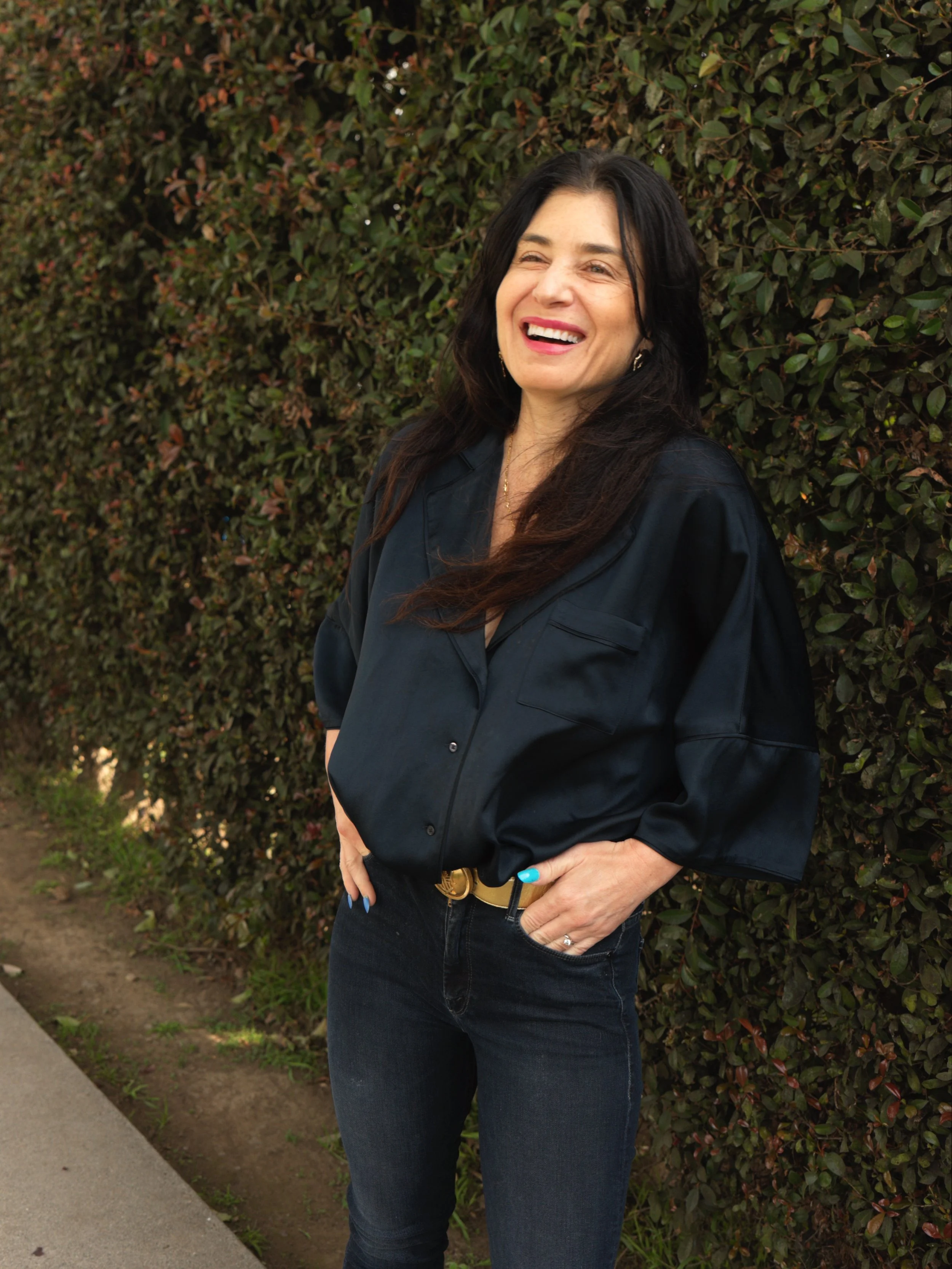
CREATING ART FOR THE SAKE OF IT
JP: I know for a fact that I shared this fund [with you]. I have The Aleksander Fund for women who lost a child, which both of you, unfortunately, are in that horrible club. It was born from Aleksander being born a stillborn. [His mother] reached out to me because of this community I've built. Because of you. Because of your work and [the fact that I would share] your work. Then I had this site people wrote on, but how many people have come up to me and shared with me that you've saved them because they feel less alone? Whatever it is, particularly around that awful thing. But it's so remarkable. Lately, I've been making art. Sometimes messages just come through, and I don't even know [where they come from]. I noticed I keep writing, ‘You are held.’ I'm such a cliche, but I need that obviously. I didn't realize it. I was writing ‘make shitty art.’ ‘Just make.’ This idea of [making] for the sake of making. It also begets the question—which I'm eternally playing with—of who gets to say what’s shitty or bad.
ERB: Plenty of people have opinions. That’s always been true.
JP: Exactly. My baseline — because we're never done being formed, I suppose — but I was eight when my greatest trauma happened. So, I decided I'm a bad person, and that was that. Lock the door. So I decided I’d teach these online writing workshops called Allow. My thing was, ‘I am bad.’ So I begin [by] turning bad on its head. I open it always with, ‘Are you willing to be bad?’ It's a playful wink. But what I'm asking is, ‘Are you willing to make art or write just for the sake [of it]?’
ERB: To not be good at it.
JP: I think it's so fun, and people get giggly. It's on Zoom, and I ask, 'If it's possible, always [have your] cameras on.' Because everything I do is about connection. I'm bad at everything except that. I could see that a couple of people cannot play with the idea of allowing themselves to suck. So then I go, ‘Write about a time you were bad.’ And even people who've done this with me a million times… It's so interesting because it’s fun. I mean, that prompt could lead anywhere. But then you start to unpack, ‘What is bad? And who is the arbiter of what's good and what's bad?’ Yes, some things that are so cliché. But the idea of creating just for the sake of it is so important. Right now, especially. At least with my experience, so much of it is about what’s saleable and content, and it's veered so far away from that.
ERB: Well, if you monetize art, you have to. I don't want to be like, ‘Don’t monetize it.’ Because I mean, I need to make money too. I need to make a living. But good art, bad art, whatever. That's a capricious, completely subjective sort of determination. But the making of art is wholly good. It's inherently good because it comes from the best part of human impulse. Even if humans are in a rage fit or sad or angry or feeling this way, the act of making is the oldest, oldest thing. God, why do I always talk about the Bible in interviews?
JP: If I'm not mistaken, you studied at [Harvard Divinity School].
ERB: It's basically… from nothing. The Bible didn’t fall from the sky. Sorry. But the old stories, these myths that are thousands and thousands of years old… People were like, ‘Why are we here? How did our bodies get made? Why is the world like this?’ So out of darkness came something.
JP: Let there be light.
ERB: People or animals. Did those things happen in that order? Like in the creepy children's Bibles? No. But when you're sitting down to create something, you start at a blank space, a blank canvas, a blank page. There's no reason to be afraid of it. People are always like, ‘Oh, writer's block or artistic block.’ I think it happens, but don't think of it as a block. It's a gestation, right? You look at something, and you're like, ‘Okay, I'm going to mess around with this for a little bit. And then I'm going to pull away.’ I'm not going to clench my butthole and white knuckle my computer to try to get something out of myself because now I have linked art to capital, to enterprise, to capitalistic motivations. Yes, at some point, we have to do that if we're professional artists, and there are a lot of things that have to be negotiated. But there isn't a negotiation between the artist and what they're making. That is a pure exchange.
JP: Truthfully, I did not discover that [until later in life]. I think I did with poetry. I find God in community and poetry. It sounds so woo woo, ‘love is my religion,’ like Lenny Kravitz. But I guess I felt that with poetry, and then I stopped writing poetry. My book was going to be called ‘You Get to Have This,' and that's because… After I bought my house, I was like, ‘I’m happy.’ It was a conscious thought, and I caught myself. I was like, ‘You don't get to be happy.’ Because that was my whole life [what I told myself]. And in this moment, I literally told that voice to fuck off. It was so interesting. I [thought], ‘Like hell.’ And I wrote, ‘I get to have this,’ with rage on a sticky note. I put it on my wall, and I shared it on Instagram, and so many people [reacted]. There's something to that, and it's not a material thing. It could be a side effect. But I didn’t think I got to write poetry. I always compared myself to you because … I didn't want to be you, but I wanted to be like you. I thought I was going to have a life of academia. I was at NYU, and then I ended up [at my] summer job. 14 years [later, I was a] career waitress. And then, when I finally started writing again, I couldn't get away from Yoga Jen. I was so, ‘But I want to be literary.’ And now I'm so proud. I don't give a fuck. As long as my book gets into your hands, I don’t care what category you put it in.
ERB: That doesn’t matter.
JP: You are by far [one of] the top three smartest people I’d ever met in my life.
ERB: Am I number one? Or two or three, though?
JP: I don’t know. You and [the writer Karina Wolf]. I mean, she's a genius IQ. It frightens me. You and [Karina] might be a tie in my life. But I didn't think I got to write poetry. But with making visual art, I’m like, ‘Oh, it’s the making that’s become my medicine.’ My stepdad is so proud of me. But he'll be like, ‘I really love it. I don't always understand it. I mean, some of it I don't even know if I like.’ Then one day he calls me, a year ago, [and says], ‘I had an idea. You should get a group of trusted advisors, a few of your really good friends, and show them stuff and ask them which ones they think you should share to maybe sell. I was like, ‘Hell no,’ because then it becomes about them and what they want. And I have that with my [publisher]. You know, I had a book deal. So ultimately, no matter what, with a book deal… Yeah, you write what you want. Kind of. But they have to sign off on it. So I was like, ‘This is the thing that is for me.’ And the feedback I get most about my art is regarding the freedom around it. And that is because, in quotes, I don't know what I'm doing.
ERB: Nobody does.
JP: Point being, I’ve let go. Because I don't know what I'm doing, I don't know if it's finished. I don't know what's good. And there's such a freedom in that.
ERB: The not knowing is a creative state, though.
JP: But I had to embody it. The brain [usually gets in the way]. But when you actually embody it, it's a whole different thing.
ERB: Of course. If you take the analogy of writing or an analogous situation of writing, I don't sit down and be [say], ‘Okay, if I have a character—here’s the scene. And it has to have a scene around the scene.’ I don't think about craft points. I'm not thinking about that. I’m writing a character I know.
JP: It's annoying because she can be eating a sandwich, watching SVU—I know I keep saying SVU, but there's a reason—and writing an essay. And it's award-winning, you're bawling [by the end of it], and it's the best thing ever. What the fuck? She's like, ‘I know.’ I love that because you're the smartest person ever. It's in you, but all that goes out the window in a way, right?
ERB: I mean, I hope it does. Because I think when I’ve had my best writing moments, I haven't been thinking about the doing of the writing or what it looks like.
JP: You said something, and I got the chills, and I'm so glad you recorded it because I [want to revisit that later].
ERB: I have no idea. It comes in, and it comes out. Think about it. But why do you think people have ideas in the shower? Because they’re in [stressed and in their heads]. Any creative experience on stage or a musician with their instrument… and your instrument as a writer is words, or it's paint or whatever… When you see someone doing that, it's beautiful. It's so deeply human to watch somebody create something out of nothing. And so when you're in that experience yourself, [it’s a beautiful thing]. I mean, it isn’t always like that. This book was fun to write because it was, first of all, not so sad.
FINDING THE FUN
JP: I love that you said that: ‘This book was fun to write.’ Because I think, well, one, fun is so underrated. But even when we're writing about painful things, fun doesn't always have to be ‘rah rah rah,’ but the idea of having fun or enjoying it is so important. Maybe it won't always be the way, but I think there's something so important [about that].
ERB: There’s a difference between meaningful labor, which I would say art — or whatever and work — meaningful labor is going to tax you in a different way than working extra jobs. Or the kind of things that so many of us do to stay afloat in a dying capitalist economy. I think what is really crucial for people at this moment in time is to understand that they have the power, no matter what situation they're in. There's a story in there that they can tell in a way that feels organic and good. And that it doesn't matter if anyone ever sees it. Hopefully somebody will, but that isn't the point.
JP: I mean, it's interesting because I feel like these are like companion books. We used to do these retreats [together]. And my stuff—as you're teaching, as we grow—has changed so much. I don't do yoga so much anymore, but I used to combine the yoga-ish [philosophies]. Because a lot of the people that came were like, ‘I ain't never done a down dog.’ But the reason I did that was that I realized… As someone who always had all this armor up, the times I was most vulnerable were when my defenses were down. And so I would give this really raw example of when I was very anorexic, I would eat in my sleep. I would wake up because I was obviously half asleep, like a liminal space, but because my defenses were down [I didn’t question what I was doing]. Or have to get drunk—same with sex. And so I was like, ‘You know how when you're really tired, you’re emotional?’ And people go, ‘Yeah.’ So the idea of the yoga part or the body part is to get you in that state without having to kill yourself or be drunk. This thing you're talking about, about how when you're in the shower, how you're not all clenched up, it’s about softening and allowing, like my tattoo.
ERB: It's surrendering to it. The first time I felt this way as an adult was when I was in a class. I think it was French feminist literary theory.
JP: Of course it was.
ERB: I was like, ‘Wait. What?’ You know you're trying to follow the lecture, and I was half paying attention. And all of a sudden, I had this idea for a short story, and then it just kept coming and coming. I was like, I don't know what they're saying about whoever that is…
JP: This was when you were in college?
ERB: Yeah, not undergrad. In grad school. In college, I took creative writing. But you know, I would have creative bursts when my brain was distracted—like thinking about what they are trying to say. That's why I like to have things going on in the background. Because part of my brain, the critical part, that wants to make sense of it all, goes away.
JP: That makes so much sense.
ERB: The creative brain has really good boundaries. If you tell it, ‘You’re a piece of shit. You can't do this. Why don't you make any money? What’s wrong with you?’ It’s like, ‘Okay. Byyyyeee.’ It doesn’t respond to bread crumbing. It doesn't respond to any of that. It’s like, ‘Oh, you’re kind of good today.’ The way that we talk to ourselves when we're trying to make art—this is the biggest hurdle for people. Or when I say to people, ‘Okay, we’re gonna do an exercise,’ and everyone's like, ‘Yes,’ and I'm like, ‘There’s no way to do it right or wrong.’ They’re like, ‘What?!’ And I'm like, ‘No. Really.’ They’re like, ‘So is the way to do it [like this]?’ I'm like, ‘No, no. There's no way to do it wrong, and there's no way to do it right. You can do whatever you want. It's the doing of it that matters.’ It's like when that hook gets released, they're [blown away by the freedom of the task].
JP: With my son, I noticed this thing recently with bowling. If he's not good at it, he doesn't want to do it, and I want to instill by living this way… He watches me. He's watched me start art. But by modeling it. It’s not always about [the end] result. Rarely, really. It's interesting, though, what you're talking about. The thing for me with why I can't do what you do with the TV on has to do with my hearing loss.
ERB: That makes sense.
JP: Without my hearing aids, [I’m] totally deaf and with them… Right now, I have them turned all the way up to 100. The hardest thing for me is speech clarification. But I also have sensitive ears. So it's the most distracting. But this book I wrote… I mean, I sold it, and I swear I wrote it five minutes before it was due. I was like, ‘All I've done is paint. I made like a thousand paintings.’ But what I realized is—and in a way, it sounds eye-rolly—but I painted my way into the book. Because all that was what you're talking about. It was a [matter of] opening up a different channel in a way.
ERB: I mean, I taught my way into this book. When you learn to be a teacher in creative writing, you don't learn anything. I talked about it, actually… In the first creative writing class I taught, I had no idea what I was doing.
JP: But you do now.
ERB: But now I do. But I realized that it wasn't really about me. It was about the energy in the room and what people were doing.
JP: But you’re saying that with a wink.
ERB: I do, and I don’t. My daughter says that. I’ll be like, ‘Do you want to do this?’ She'll say, ‘I do, and I don’t.’ I'm like, ‘What?’
JP: Well, when we taught our retreats together… Same with Lidia Yuknavitch… I had the privilege of doing this with both of you. I would take your part or Lidia’s part — and so much of ‘On Being Human’ and this book were written from Lidia’s classes. I remember these very specific things that you taught, and you're such a generous teacher. I remember the exercises you had us do. It was something like, ‘Write the corniest or the worst or the most…’
ERB: Cringy thing you ever did or something?
JP: You didn't use the word cringy, but it was soap opera-y…
ERB: Oh, yeah. Melodramatic versus straight.
JP: And very tangible things. I'll never forget the senses. You would always talk about smell and these things that stuck with me. And Lidia, too, but your generosity as a teacher is [special].
ERB: Oh, thank you.
JP: So when you talk about [learning] to be a teacher. Sure, there are certain things, but there are also some things that are just so inherent in us as people that make us good teachers or great friends. And for you, it’s the generosity of listening and of hearing. And Lidia is the same. Even if [the outcome of the exercise] would be so, ‘There's nothing in that.’ You find something.
ERB: One thing.
JP: You remind people, ‘Look at that. You did that, and that works.’
THE LUDACRIS EXERCISE
ERB: I have an exercise. It's not in [my new book], but I call it ’The Ludacris Exercise.’
JP: The what?
ERB: Ludacris. Like the rapper, ‘Take that, wind it back… make your booty go…’ You find the one thing, and you wind it back. You don’t wind it, but you pull on it, and then it all winds back or unravels. It’s not quite the right metaphor. But if we take that and wind it back. Just pull it back and see what's in there because you don't know. But it’s finding the one true thing. This is the thing. I don't hate people. But I don't want to meet people. I don't go to that many cocktail parties by choice. Also, no one invites me. But I don't like small talk. A lot of people do. I don't want to meet people and talk about, ‘What do you do? How many kids do you have?’ Because those conversations can be really painful. Like, how many kids do you have? Do you say, ‘I have one? I have one that's dead.’ Then what?
JP: Emily walks up to people, and she's like, ‘What's the worst thing that's ever happened to you?’
ERB: ‘Are you sad?’ But when people write, I want to meet people. I like to meet people in a situation where what’s going on between the two of us is an artistic exchange. It’s also more than that. I do this thing called Instant Workshop, which sounds like noodles, but whatever. Anyway, I'll have an exercise, and everyone will read it out.
JP: You do it in class?
ERB: Yeah, I'll do it in class. They'll read it aloud. I'll say, ‘Here are the three things that I noticed. Here's how I would move them around. Here's where I'd start. Here's where I'd end. Try that. And see what happens.’
JP: What if they're like, 'Who asked you?’
ERB: They're also like, ‘Well, I don't really want to start there.’ I'm like, ‘Great, don't start there. But try it. Try that beginning. Try this ending. What if that was the beginning?’ Being playful about it instead of being locked in.
JP: [I love] your perspective and the way you look at things. The other day we were talking, and I said something to you, and you're like, ‘I said that? I don't remember.’ But I love that. That's happened to me. And I'm like, ‘Thank you for reminding me.’ So, losing my dad at eight, I always had this memory. And I was literally famous for it among my friends all my life. Steel trap memory, Jen. And that is because I think all you have when your parent dies really young or when you lose a kid, you have to hold on. Because that's it. They're gone. And so, I will find these journals because I have 8 billion, and they're not written in, and there will be one sentence starting when I'm 18. [They say,] ‘I wish I [had written] down more things and yet I never did.’ But I kept writing that, and I beat myself up because now I feel like I don't remember anything. And when I was going to write ’On Being Human,’ which I hired you to help me with. I should have from the beginning. I don't know why I didn’t. I fired the person [before]. I hired you, and it was magic. I was like, ‘I don't remember anything. I didn't write anything down.’ You're like, ‘Fuck writing shit down.’ You said. ‘Just find the edge of a memory.’
ERB: Take that and wind it back.
JP: Do you know how many times [I quote you]? I am huge on acknowledging my teachers. I will never say something [and claim it’s my own]. The [number] of times people hear your name or Lidia’s [out of my mouth]. I'm huge on reminding people because that saved me. I was so in my head about what I didn't remember, and you said, ‘The edge of a memory.’ At first, it gets you to be playful. Like, what does that even mean?
ERB: Yeah, exactly.
JP: And then you're off to the race. The gift in that — just the edge of it. And then there are all the things about creative freedom. Who’s to say what [happened]? Look, my sister and I were both there, and we have different versions of the past.
ERB: Of course. There’s no truth. Truth has no loyalty. I do think, though… When people are gone, they are gone. Obviously, in this lived experience, they’re gone right now in this world.
JP: We can't touch them.
ERB: But their memory—that's the thing… I feel like this has always been the case. I think it’s true for most people. Memory is as real to me as every moment in some ways. I think this is especially true for people who've lost children. Parenting beyond the grave is possible. Because we're having an experience in our minds and hearts that reenacts all of the love and the connection and the loss and the grief. That container.
JP: I see it out of my [peripheral] vision. I see you nodding, Lindzi.
ERB: It's a container. The container changes, right? So the way I remember my son two years after he died and now almost 12 years after he died are very different containers. Are they easier to bear? No.
JP: And who's to say which is true?
ERB: But all of those little containers, you live in them, and they collapse into the next one, and they collapse into the next one, and it's constantly changing. I find that comforting as someone who has lost a child. And I know in the groups that I'm in — or was in more readily 10 years ago — that was also true. We always say, ‘Always with me,’ but that's actually true. It's energy. Energy has to be replaced.
JP: So many things came to me later.
ERB: When you were 25? Or right now?
JP: Oh gosh, I don't wish I [were 25]. The only reason I would wish I [were] 25 is that my hearing wasn't as bad. One of the things I'm so proud of in this book is that I did it my way. They wanted self-help. I was like, ‘Oh, barf. Alright. Well, I'm gonna do it my way,’ but I have a glossary in the front of my own terms [used within it]. There was half a millisecond — or however long — where I'm like, ‘I won’t be taken seriously.’ That’s falling back into that thing of, ‘I want to be literary,’ or whatever. It's kind of audacious. It's my own thing. I put in the front and ITG—the Imaginary Time Gods—because I think, especially for women, these narratives of like, ‘Oh, I’m a late bloomer’ or ‘It's too late.’ I just caught myself saying it. But these things you're talking about, I resisted that. [The idea] they’re always with you. I had such a shell around me. Even now, crying sometimes still catches me off guard. Only recently I [have felt] my dad with me, which feels really bizarre because he died when I was eight.
ERB: Well, you're ready to experience him now.
JP: That’s what I mean. It's all of a sudden, especially with getting sober. But the things that I used to roll my eyes at, I'm like, ‘Okay.’
ERB: You should know I'm not a big crier. I have never really been. Part of it is a protective mechanism, and part of it is that my crying is writing. I cry a lot when I write. Or I laugh.
JP: Do you?
ERB: I look like I'm completely off my nut. I talk to myself. I do things with my hands. I'm sure I look completely deranged. I have a lot of cats. I look even weirder.
JP: You have a lot of cats? I thought you had one.
ERB: No. There are a lot of them now. I love them all. So they're around. But I think that's where the energy of crying comes out for me. I mean, I definitely cry at sad movies. That's why I don't watch them. And happy movies. But what I'm trying to say is when I'm writing, I feel like I'm in a vulnerable space. It’s just that it's a different kind of space. I'm vulnerable, but nothing's going to happen to me.
JP: It’s a safe space. I was going to say… When you talked about when Ronan was diagnosed, and you said, ‘You had your internal life.’ Is that how you worded it?
ERB: Interior life.
JP: I know that about you. You’re… I mean, tough isn't the right word, but I think of you as someone tough. Like you could kick my ass. You work out so much. But your writing is so vulnerable. Process isn't exactly the right word either. But that's where you do that. It's not that you're not feeling it.
ERB: That's where I put it. I think when you've gone through some really hard things, you can be a bit of a hard stick to cry or the reverse. It's hard to make me cry. Other people who have been through similar situations might cry all the time. We have a mutual friend, Julie, and she's very easily physically moved, and she cries a lot. And I love that about her. Everyone's different in that sense.
JP: I used to be so envious [of her]. I thought I was broken [because I couldn’t cry]. It became physiological, and I thought I was dead inside or something. I would see that, and I would think, ‘Why can't I do that?’ …. I felt emotionally constipated, and it doesn't feel good.
GETTING OUT OF YOUR HEAD
ERB: No, it doesn't. But I also think, too… People always say, ‘I don't know how to be a writer’ or ‘I started too late. I don't have anything to say. I don't have the right mind.’ The biggest gift you'll ever be given — besides love and death — is your brain and your experience. It doesn't matter who you are. Nobody is you. So everyone is unique and singular, and we're all not more important than the other person. I have never, ever been more grateful for whatever goes on in [my head] than when I was writing about Ronan. Now I can marshal all of the things that I've been studying my whole life for a really powerful purpose. If I hadn't had that background, if I hadn't gone to all these religious schools, it would have been different. No one can give you your life experience. And to give away power—I hate that phrase—but to say, ‘Oh, I’m never going to write a book because my story is not important.’ Hearing that from someone else. ‘Or it won't sell. You need to have a platform.’ It doesn't matter. No one can tell the story that you can tell. Only you can do that. No matter what the modality. Your brain is your brand.
JP: So much of the stuff I do, I want to get out of the brain. Lidia used to do this thing that she borrowed from [cartoonist] Lynda Barry that I now do — where you do a self-portrait with your eyes closed with your non-dominant hand.
ERB: That's a cool idea.
JP: It's wonderful. This is another thing. Most people look at it and laugh. I did this last year. I've gone into Charlie's class—first grade, second, and third—and I taught them stuff. And one little girl was so critical of it, and my heart broke because I’ve never in all the years seen this. I would say, ‘Write one sentence, a loving sentence.’ They write it so quickly. I go, ‘If you took a selfie, a lot of people would struggle with writing something loving. How come it was so easy?’ And most people say, ‘Because it looks like a three-year-old did it.’ Sure. And it's ridiculous looking. I have this thing called the ‘Let Yourself Off the Hook’ book. So it's like, ‘When am I going to let myself off the hook [over] all the things we beat ourselves up for?’ But we’re letting ourselves off the hook before we even start. By closing your eyes and not using your dominant hand, it's not going to be Pulitzer Prize-winning. It's not going to hang in the whatever [museum]. And so already you're free, right? So this little girl, it broke my heart. Not only was she a child. so that getting into that space. Right. Then everyone's laughing, and I'm like, ‘Wow, it's fascinating.’ So what if we entered the creative process more from that space? Sometimes it's really hard, like most simple things. But doing things like that or exercise or something you're not quote unquote good at… ‘I don't have a creative bone in my body. I can't draw.’ And then make art from there. So, it’s like there's a softening. But I'm curious, going back to when you talked about the holiness of the creative spirit, but you said this book was more fun to write. Why? And what do you mean? What is this book?
ERB: It's a book of essays. It's designed to be a craft book, but it doesn't break it down into doable steps. It’s [for] if you want to learn how to create in an intuitive, non-traditional way, these are the techniques that I use to get people inside the story. There's stuff in the back, but it also [explores], ‘Why does art matter? How can you leverage the mattering of art in your own life in whatever small way feels right to you?’
JP: What do you mean by that?
ERB: Let’s say you always wanted to write a book, and you work nine to five at a corporate job, and you don't like it, and you're just like, ‘I don't have time. I don't have energy.’ In this book, I talk about what I call rocket writing. There are no rockets. It's 10 minutes a day. If you can take 10 minutes a day, you don't even have to write. You can just sit down and read something [for] 10 minutes a day, engaging with whatever project that is, even if it's to go outside and look around.
JP: You’re saying connect with it. With some kind of divine spirit?
ERB: Something like that. I also feel like this book marshals a lot of my interest in how old dead white dudes framed experience. Philosophers of the 19th century and biblical scholars, how they framed meaning and experience, and how those two things work to create one another, and how that helps to think about creativity. For example, this has nothing to do with dead white men, but, well, actually it does, but anyway… Put a pin in that. Sometimes when people are working on a book, I'll be like, ‘Okay, so you've written this book. You’ve got a draft, give it a shape.’ And they're like, ‘What?’
JP: Like a hexagon. Triangle.
ERB: When you think about your book, what's the first image that comes to your mind? They'll [say], ‘A street,’ and I’m like, ‘Okay. What about the street?’ This is an exercise I went through with a student. She’s like, ‘It’s the dividing line.’ I'm like, ‘Is it just the dividing line?’ She's like, ‘No, it's the two lines on the outside.’ I'm like, ‘So two parallel lines? That’s the shape of your book.’ And it was a book about giving a child up for adoption and then going to find that child years later. So, two lines. Every book has a shape. It doesn't have to matter [what shape], but if you give it an abstract shape, you have now externalized it all.
JP: You’re speaking my language now. Because I stopped being a kid when I was eight. And I think that's why I'm so immature now. But there's a playfulness. I was never playful as a kid. I was serious. There are no pictures of me smiling. I was not playful. And now I'm so playful in all the work I do. I'm known for that. But what you're talking [about], there's a playfulness to that. Whenever I get the chills, it means something’s true. Tone can’t be read in text, so my God. If that’s written straight, I’m going to sound like a douche: ‘When I have the chills, it is capital T truth.’ But there's a playfulness to that. That’s also what I meant about your teaching and your generosity. There's a playfulness to it.
ERB: You cannot take yourself so seriously. I have a whole section of one of these chapters called, ‘Unclench your butthole.’ You cannot write like this. You can't do anything like that except take a dump. Stop it.
JP: I say that all the time. ‘It makes my butthole clench,’ and everyone does a double-take. The only other person I've heard say it is my hilarious lesbian friend. So when I heard you say it the other day, I thought, ‘This is hilarious that we both use that gross expression.’ There are so many parallels [between what we both do]. That's why the glossary is at the front [of my book]. It’s all about not taking yourself too seriously. Like, get over. There's a whole thing about creativity and finding a way. So much of writer's block is also a self-sabotaging thing. It's just a way to not get started.
ERB: It’s avoidance behavior. I mean, I’ve been working on a novel. I think I had the idea for this novel when I was 20 or something. It's taken all these different shapes, and I used to feel bad about it. When I wrote this book [‘I Would Die if I Were You’], I was like, ‘I’m going to take some of my own advice.’ I'm going to get in there, and I'm going to make this thing, and I'm going to play. Now I'm not writing it, but it's in my mind. And when I go to the document, I call it ‘the big ass document’ where everything I'm thinking about gets poured into. Notes or Wikipedia pages or whatever. When I go in there, I read from the bottom to the top or the top from the bottom. And I'm just like, ‘Okay, this is fun. What do I find out today?’
JP: See, I love stuff like that.
ERB: And then that's the space [where] your creative brain says, ‘I'm not like this.’ So no one's holding me down. No one's berating.
JP: And you're not trying to get it right. I wrote a poem. A lot of times, I'll take a poem, and then I'll turn it into prose or vice versa. I wrote a poem once called ‘In Praise of the Ordinary,’ and then I made [it] a part of the book instead. But it's like, ‘What are you trying to get right and for [whom]?’ And I was horrified by the answer. It was always for them. The idea of 'what are you trying to get right?’ And always trying to be extraordinary, and how the most beautiful things are the ordinary things. Most of us miss them because we're too busy looking for the extraordinary. But the idea of trying to get it right [is wrong]. When you start to play, we let go of that, and to me, that's where the magic happens.
ERB: You can see kids do that. I think I talked about this… I can't remember what I wrote in there. But my daughter was once telling a story, and she opened the book, and she's like, ‘Do this, do that. Then she went into the thing, and it was a portal. It was a long journey. And then she saw a giraffe without dots.’
JP: Yeah, I read that in your book.
ERB: She was just like, ‘These butterfly fairy wings are going to go on your head, and the cat's going to eat them.’ They can engage with their imagination because the stakes [aren’t high]. They don't know the stakes. Because there are no stakes.
JP: There's another thing you taught me when I was teaching yoga. And with “Poster Child,” I remember there was a composite character. I'm like, ‘What's that?’ I'm butchering what you said, but it was like five different girls, right?
ERB: Five different mean girls in one mean girl. Right.
JP: The inner asshole is like a composite, right? I mean, who knows where [the thoughts come from]. It’s either the things people told us or what we told ourselves, or like me… My dad [said], ‘You’re being bad,’ and then he [dropped dead]. It’s all the things [we tell ourselves]. Watching our kids engage with their imagination [is inspiring]. They also haven't been inundated yet with all those other voices and have made them their own.
ERB: Eventually, the world impacts us all at some point, and we internalize things that aren't ours to carry, but I think if you give a kid the tools [you’re better off]. I mean, [my daughter] Charlie is 11. Who knows what will happen? But I just say to her, ‘There's no perfect way. There's no right way.’ She may not adhere to that nugget of wisdom when she grows [up], but even so, just hearing it [is hopeful, I hope]. I had all my I had all kinds of issues and have all kinds of issues.
JP: But it's also not about you telling her that. It’s what you embody.
ERB: But my parents, who were very Protestant, very religious—not crazy—were just like, ‘Everyone has value.’ No one had to say that. We would visit the old people. We had people who were in a house sleeping in our house, and I was like, ‘Who are these people in the kitchen?’ They were hitchhiking on the way home, and my dad brought them home. You wouldn't do that now. But [it was] this idea that no one is worthless. That's the only thing that religion is actually supposed to teach — that nobody is worthless. And that’s it. Everyone matters. Certainly, there are people I don't like very much.
JP: Who are they? Can you name them all?
ERB: Well, duh. Trump. I’m like, 'Well, there are no true villains.’ And I'm like, [‘Or are there?’]
JP: I am the same. I can't stand. People go, ‘There's no good and bad.’ I'm like, ‘Yeah, actually there is.’ Shooting at the school, yeah, bad.
ERB: That should be like an accurate statement. And I think in a sense it is. Who knows what happened to anyone as they were coming up that changed them? And we don't know the unique experience. We don't know the unique makeup of someone that's going to make them into a sociopath or not. So much of everything is outside of our control. Another thing that I talk about in this book is the idea of working inside of chaos instead of trying to control it. I don’t know if you know this about tornadoes, but let me tell you. The shape of this book is a tornado. When you go into a tornado… I've never been inside one, just FYI. But there are reports of people doing it. There's a moment of total calm. So this dude, some man in Texas in 1912, was one of the first eyewitnesses [who experienced the] inside of a tornado that lived. He was completely still inside, but there were all these tiny little wild tornadoes and all of this stuff going around [him]. And he’s just like standing there. He was a farmer. He was like, ‘It was utterly calm, almost like I imagined heaven or death.’ So this book is meant to be like—if you have a story where people are like, ‘I would die if I were you,’ or ‘I can't imagine what you're going through….’
JP: By the way, I was joking… I was being sarcastic [earlier] when I said, ‘People haven't said that to you,’ because I know they did.
ERB: And they still do.
JP: Back in the day, when I first met Emily, I was obsessed with Wayne Dyer, and everything out of my mouth was ‘manifest.’ My brand was manifesting. And it was like, ‘Wow, you manifested that…’
ERB: ‘You must have a bad karma debt.’ [People have said] awful things.
JP: ’I would die if I were you,’ that just blows my mind.
THE THINGS PEOPLE (SHOULDN’T) SAY IN GRIEF
ERB: I mean, there are a lot of dumb things people say. What you shouldn't say to someone who is grieving is… THAT. [Or] ‘I would die if I were you.’ It shouldn't be, ‘It’ll get better,’ because they don't know. ‘I can't imagine,’ because that's not [helpful]. Someone else’s failure of imagination is not on the person who's experiencing it. You wouldn't be sad if you couldn’t imagine. So it's inaccurate as well.
JP: I think about all those stupid things [people used to say to you]. And, oh gosh, with Rob Reiner's murder.
ERB: I think it’s what Lindzi said [earlier when we were talking off-camera], actually. It’s hard to wrap your head around it. … It's just awful.
JP: The way people said it to you is a different kind of [thing]. There’s an ‘othering.’
ERB: It's basically like, ‘Should I then go jump off a roof?’ Is it a suggestion? It's not a thing to say.
JP: ‘You’re so brave.’
ERB: That also isn't very helpful. I think bravery is people who go into a war zone and are actual soldiers, and have to be brave in these moments of intense physical danger. That's brave. Having to deal with the circumstances of your own life is called being an adult. Whatever they are — it’s called being a person. Not even an adult. Kids have to deal with hard stuff. It’s not that we can't say, ‘Wow, good job.’ It’s both / and. ‘Good job, but also.’ That’s the deal. That’s the deal of being a human being.
JP: Isn’t it funny the things we remember? Like I remember the whole menu of The Newsroom, and I don't remember what I had for dinner last night.
ERB: Nobody does. After menopause, nobody does.
JP: I’ve always been this way. But I remember things… you’ve been saying this for a long time about the brave thing. You’d use this analogy of a woman in a village carrying water on her head. But I do think with bravery, some of it’s [personal]. Or maybe I'm thinking of courage, the difference between having courage… doing something that terrifies you.
ERB: And doing it anyway.
JP: Like, the thing is… We’re in my apartment right now, and I was telling you this the other day. I used to make all these silly videos and not think about it. I’m like a whore with the camera, and people are always annoyed [while I’m doing it]. And then later, they love it. I have so many pictures of Ronan.
ERB: You do. Yeah.
JP: I would always share my apartment and not even think about it when Charlie was a baby, and people would go…
ERB: ‘Oh, you're so brave for showing it?’
JP: ‘You’re so brave.’ What I realized was… this is also really funny because people see me as… Well, not everyone, I'm sure. Some people [see me as] really successful. Now. Also, the idea of success, I have my own definition. Am I? Hell yeah. Do I have a lot of money? Hell no. Do I have any money? No. But anyway, success to me is like, ‘I told the truth today.’ I get to do what I love. But [I realized], ‘They have an idea of me that I'm this super successful person, and this isn't matching up with people's idea of what success [looks like to them].’ [Like], ‘Why is she living [like that]? Doesn't she have more?’ And then the fact that I share it. So I created something called ‘shame loss,’ which is a riff… Having almost died of anorexia… But the idea is you should be ashamed, and you're not.
ERB: Think about that comparatively. Another example of that would be at Grieftastic — where you're the thing, like the right way to grieve. So people always meet me, and they'll be like… Mostly men, which is interesting… Not that I'd meet all these men, but when I meet a reader who's a man… Or I spend any time with someone who's a student… They’re like, ‘Wow, I just thought you would be so dour and so sad, you know, because so many bad things have happened to you.’ And I'm like, ‘Well, you're a man, so let's bracket that.’ But also, I’m my own person. I don't live in these books. They'd be like, ‘Oh, you're so funny. Why are you so funny? Why aren't you sad?’ And I'm like, ‘Why do you want me to be sad?’
JP: It doesn’t fit in [with their expectations]. I remember when Ronan was…
ERB: It’s like, I've been plenty sad, trust me.
JP: I know. I remember toward the end… and I so appreciate this about you. I call it ‘the school of whatever works.’ As long as you're not intentionally hurting yourself or anyone else, I would love us all to live that way. But you did it your way. I remember there was a certain [fear of], ‘You're not grieving the right way,’ or ‘You’re not mothering the right way.’ But I remember we were at a restaurant, and you had to feed him, and you were giving him cheesecake, and someone was looking at us. Or you brought him to a bar. And there are so many judgments—like you’re not being a person the right way. Meaning the way [others think you] should.
ERB: Yeah, you don't live in a Sears catalog from 1987. Like, no, that's not my life. Or people would come up to me and say, when I was with Ronan—they'd be like, ‘It makes me so grateful for my life that I don't have to live yours.’ This is the meanest thing I ever said…
JP: It’s astounding.
ERB: I said, ‘That’s too bad. Well, that makes sense because my life's way too good for you.’ Oh, snap.
JP: Lindzi, have people said awful things like this to [you]?
LS: Absolutely. People say the stupidest things. This is the one thing I will say, though...
JP: That's the only thing you've got to say?
LS: I have so much to say. Everything resonates. Every little bit of that. But what I try to tell myself is that I've probably said stupid shit too, when I didn't know what to say. So I try my best to see it from that lens.
ERB: Me too. But it’s hard.
LS: People say the stupidest.
ERB: They say the stupidest thing.
LS: And it is an othering.
ERB: It's an othering.
LS: I think it's a way that they are protecting themselves: ‘Well, that's you. That's not me.’
JP: Absolutely, I hope it's [not] contagious, right?
ERB: Now the emotional labor is on you to make them feel better about the thing that happened to you that they claim they can't understand because they don't have the imagination to do so. What? It's an impossible bind, at a party or at a thing. And people don't want to hear [it]. A lot of people, you can actually kind of [maybe] judge character. But if people don't want to hear about something really hard, you know they can't really know you in the way that you want to be known—if that’s the case.
JP: Well, there's a surface level [type] of person [who enjoys] small talk. And doing all of this work with women who’ve lost children, what I love is—it’s taught me, and I'm pretty great at being able to bear witness without feeling—, but they taught us to bear witness rather than trying to fix [it].
ERB: You can’t fix it.
JP: There are people who just cannot be with it.
LS: I have to jump in quickly to simply share… Based on this topic… The most egregious version was when I was at a dinner where I was stuck next to this person. You don't get into [our backgrounds] with someone unless you can tell they want to.
ERB: Yeah, of course.
LS: She's the one who saw my phone, which had both my kids on it, because [Evan and my son] did get to meet [before she passed away].
ERB: Oh, that's awesome.
LS: It was amazing. It was a blessing. Evan and [my son]—he was [three] months old when she passed. So they were able to meet. Bottom line is she was pressing me on—
ERB: All the kids you have.
LS: All of that. She pressed. So I thought, ‘Okay,’ and then you share as delicately as possible your reality. She then pretended to take a phone call [in order to get out of the conversation with me]. And [she] spent the rest of the night with her back to me. And by the way, this is somebody who runs a very well-known organization that’s for families and for underserved communities.
ERB: That is so shitty.
LS: I know.
ERB: I hate that that happened to you. And I'm not at all fucking surprised, but I really want to punch her in the face.
LS: Oh, it was unbelievable. So anyway, yes, I get it. Sorry [to interrupt].
THE SORRY BANK
JP: You know my thing… ‘The Sorry Bank.’ Anytime there's an unnecessary apology, you can Venmo me—Jennifer-Pastiloff. Or anyone. Do it with a friend or donate it. But the idea is it’s either going to break the habit or break the bank. But when I do it in my workshops or retreats, you start to get so aware of all the ‘sorry’s.’ So apologize if you're an asshole. I can't stand people who are like, ‘You say never apologize, Jen.’ No, the art of an apology is beautiful. For example, if someone gets emotional or there are so many ways… I'll say, ‘Sorries are insidious.’ Let's say Emily writes in my workshop… if you took it and then someone's like, ‘Well, mine's nothing like that.’ That's an apology. All the ways that we minimize ourselves. Sometimes throughout the day, it'll be like ding, and I'll get $5 [for an] unnecessary sorry. It's incredible. So the point being… You said sorry. You owe me five dollars.
LS: I always say that my memoir would be called ‘Apologetically me,’ because literally I feel like I've gone through my life saying, ‘Sorry.’ That's women.
ERB: That’s a very common, gendered thing in some ways, too. Not always.
JP: That's my lived experience. But it's a fun thing. It's a way to—
LS: Break the habit.
JP: So anyway… But your contribution… You sharing that—ain’t no way required an apology.
LS: Well, no, the reason I say this [is] because I do—traditionally speaking—try to stay out of this and let you guys engage. It's not about [me]. I'm a third party. Fly on the wall.
JP: I know, but this is a very unique situation.
THIS SEASON OF LIFE
JP: Well, I think one of the most interesting things for me is… we’re sitting here with these crystal glasses. The fact that we're drinking fake champagne [is] because in November I was one year sober. It's hilarious because if someone just saw the photo, they wouldn't know you know, and I’d be horrified. Because I've been going around telling people I'm sober now. I hate labels, but I was, let’s say, a ‘good’ alcoholic, because I only drank in the dark at night. I didn't day drink, really, unless I was in Italy. But the sobriety thing… It's hilarious to me that we're sitting here with fake champagne. That's a whole other thing. But I did want to address it in case there were any photos of me just holding a glass of wine. I'm sober, everyone.
ERB: It's faux.
JP: Not that anyone cares. At the end of the day, I also don't owe anyone anything. I don't have to justify it or apologize. I mean, I wouldn't be who I say I am. … But in a million years, I never understood when people drank fake beer. I was like, ‘That is so weird,’ because I love the taste of alcohol—except gin—but I drank for the feeling. So I did not understand fake alcohol. And now it’s fascinating to me. I don't know if it's psychosomatic, but there’s something about the ritual of it. I still have the same addict [tendencies]. Even when it's fake wine, I drink the whole thing. It's all or nothing. The reward system goes off in my brain—like this is a reward. Whatever works. People will be like, ‘Does it bother you if I drink in front of [you]?’ I would always say until recently, ‘I always want to drink whether you’re drinking or not.’ Then a month ago, I was like, ‘Oh my god, I actually don’t.’ This is new. You know that expression that’s all over my book, ‘You can’t believe everything you think?’ That became so clear to me because I never could imagine myself not drinking. I didn't think I could, and I could not have admitted that before. … So the fact that I've gone 13 months now…
ERB: It’s a big deal.
JP: It has changed me on so many levels, but I always say I'm a witch, and whether I came [into the world] with it [who knows]? But then I think having my deafness has exaggerated all my other senses, but then since I stopped drinking, it's off the charts—my intuition. But I think it's just that I'm not dulled all the time. So that’s one big thing for this season of my life. Also, it’s a dark time. When have we not said that about the world? But it feels particularly dark. I didn't start drinking at eight, but I started disassociating when my dad died [when I was eight]. And so when my book came out in July, I had… I don’t know what to call it… Not a nervous breakdown, but everything came up. Because it was the first thing I'd ever gone through, an event where I wasn’t [drinking].
ERB: [That’s a] milestone.
JP: Yeah. I felt embarrassed. I was confused and felt bad. I'm like, ‘What's wrong with me?’ Nothing, but [I was struggling]. The whole thing you said, 'Energy doesn’t die.’ So everything I shoved back inside—all the stuff started coming up, which reminded me, ‘Grief has no expiration date.’ I thought I’d put one over on the universe. I'd shoved it all back [down]. Every fucking thing [started coming back up for me]. So I still feel like a raw nerve, and it’s hard sometimes. I've been… I don't know if depression is the right word… but that's what it feels like [right now]. It's like [there’s a] level of sensitivity, and it's just because for so long I was only half here. In whatever way I could be. Whether it was over-exercising, starving myself, drinking—you name it. So there's a level of presence I have now, but that I don't always want to have. But I'm not gonna drink. It’s like what you were talking about. That’s the point of being here. It’s being a person.
ERB: It's not easy, though. We all have our ways of checking out.
JP: Yeah, we have ways of numbing out. But we miss it. I mean, I didn’t allow for softness or tenderness or intimacy. I mean, I never had sex with my eyes open ever until [Henry]. I was married for a long time. I didn’t allow for anything. It feels like, ‘Oh, I was 50 when [that changed.’ And there's a weirdness in that. Like, I’m so old. Again, the imaginary time gods—as if I should have [figured this out before now]. But that's the inner asshole, right? Well, you know, I have such a hard time. My hearing has gotten worse. I can't hear anything. With you, I'm so comfortable. But with strangers, it's so hard, because I don't present as what people think a deaf person [presents as], or because… Capital D deaf, I always thought it was how much you could hear, but it's not. It’s if you operate within deaf culture. So I don’t present [in a more obvious way]. So it's exhausting, and it's not fun—group dinners and all that. When I stopped drinking, I [would] say no to almost everything. [Anyway], so for you, what is this season about for you? At this time in your life, especially, how much [are your female friendships] saving you?
ERB: It's always been my jam, but I think I told you on that Substack thing we did. I'm starting a new literary community with Gina Frangello and Jeannine Ouellette called ‘Craft School.’ And it's a beautiful literary community that’s immersive and has healers and writers and thinkers and thought leaders and artists who come in and talk to people. You get set up with an accountability buddy. It’s this big community of people. This whole book is about… the original subtitle was ‘community, curiosity, and consciousness.’ Of course, I thought that was really cute, and [the publishers] were like, ‘What?’ But it’s about curiosity and community and being conscious, being present. The idea of the community is to make a lively community within this particular platform. Whoever you are. Like painters and writers can hold each other accountable. Go into little Zoom rooms and work together, like co-working Zooms. We're really excited about that. So for me, what I'm hoping with this book and what I do in my life as a teacher is creating more spaces for people to be creative. It’s for sad smart people.
JP: I love that. I always think that if I didn't have a sense of humor, I wouldn't get out of bed.
ERB: Yeah, you would. Well, people do. Because there are plenty of people who don't have it, but I don't know how they do it.
JP: My dad was the funniest person in the world. So thank God he passed that sensibility onto me. Especially with my hearing. Because I feel like I exist between worlds, because, again, I’m not in capital D deaf culture. A friend of mine was like, ‘You told me you don't want to be.’ I was like, ‘No, it's not that. First of all, I have one friend, and they live in Maine. No one I know [is part of this culture]. I feel so left out all the time. And stupid. Even though I know I'm not stupid. But if you sit in a room and you cannot follow, you don't know what's going on, you have to ask, ‘What?’ all the time… Guess what?
ERB: People think you’re stupid.
JP: I don't care how fucking smart you are… It's depressing, and it's lonely.
ERB: The hope for the book is just that people will read it, and they'll want to create stuff, and they'll laugh. It's funny. There are some sad things in there, too, but it's supposed to be a book about finding joy. No matter the circumstances. … Even in the most difficult moments of our lives, we can find joy. It's not slapstick. It's [about] the joy and meaning of making something.
JP: I regret that this is only in print, though, because Emily is the dorkiest [with] the voices and all of that, you're going to miss. But you're going to do clips?
ME: Well, that's why I do [record it as video], too.
JP: First of all, life is not just one way, right? In the deepest grief, you can suddenly laugh, and snot is flying, and I love that. It’s like, that's life. I think of beauty hunting… Someone once [said], I think it was Elizabeth Gilbert, ‘It's your spiritual practice.’ And I was like, ‘Oh, okay. But I call it the ‘Pulling My Head Out of My Ass Practice’ because when I get too far up my own ass or when I have to say to myself, ’It’s worse than you think. They're not thinking about you at all.’ Also, [when you feel as though], ‘Everything sucks,’ look around [and name] five beautiful things right now. What’s so amazing about it is — it’s just endless. And then we get to decide what's beautiful. But it becomes a practice, right? Practice, practice, practice.
ERB: It's a gratitude practice that's actually helpful. Yeah, it's like, ‘What’s bringing you joy?’ And it doesn't have to be a party. It can be, ‘I wrote a sentence I'm proud of that took me an hour to write. It involved labor. It involved some effort, or ‘Today I made a spreadsheet, and I never thought I could make a spreadsheet.’ [It’s] trying something [new].
JP: It breaks my heart — with me — people who [think], ‘I don't get to feel joy. I don’t allow for joy.’ Or they feel guilty when they do. The whole thing about being creative for the sake of itself… It's like, ‘Who cares?' People go, ‘You mean you just started making art? How do you know what kind of paint to use? Well, I don’t. … It brings me joy. It lights me up. When I saw the video of your daughter, Charlie, ice skating. She's so good at it. You said this, and I thought it, ‘Oh, it makes her so happy.’ I don't care who you are; in terms of circumstances, it's not a privilege thing. You get to be lit up. You get to be, right? It’s the same with the thing your parents inherently taught you: ‘Everyone has worth.’ Then I watch people beat themselves up because they don't know what lights them up. [They’ll say], ‘But I'm already 50, and I don't know.’ Then go out and discover.
ERB: Well, that's the thing. There's also a small section about jealousy. And it's about comparative thinking.
JP: And you're so great. You’re not a jealous person.
ERB: Well, no. I mean, I have been, and sometimes I am, and I have to catch myself.
JP: Well, because you're human.
ERB: When I was writing this, for example, I wasn't thinking, ‘I wonder if it's going to outsell another book.’ But also that's true. I’m doing what I'm meant to do. So, there's no jealousy. [It] just dissipates. It dissolves like Alka Seltzer. Because if I'm living what I want to do, then what anyone else is doing is [a matter of], ‘How exciting. I'm so curious. How did you get there? What did you do?’ Instead of being like, ‘Oh, I’m not there. I suck.’ Maybe that’s a Gen X thing. I think the Z's are over it. But it's a toxic way to live. It's rampant in all creative disciplines.
JP: Especially in Los Angeles within the acting world.
ERB: There's always going to be somebody who made more money on their book, who got a bigger award, has a bigger house, and makes more money as a writer. Whatever it is you want to be, there’s always going to be somebody like that. But only you can do what you are doing. So do it.
JP: It sounds like such a cliche, and it's so true. You know, I've had people [comment on Instagram]… This is so weird—this comment—and the [number] of times I've gotten it is alarming. I haven't gotten it in a while. [But] people on Instagram [would be] like, ‘I want your life.’
ERB: No one has said that to me. That's actually really funny.
JP: Emily is like, ‘Oh, really? People say to me, I would die if I were you.’ But [also they say], 'I wish I were weird.’ So something I'm proud of right now and grateful for are my friends [and] my relationships that have deepened over the last couple of years, and then more with getting sober. And some of them are newer friends. Your win is mine. Notice I'm incessantly sharing about [your book] because it lights me up. … None of my friends are jealous. We’re human. But your win is mine. Your joy is mine. The one friend I had—we’re not anymore— couldn’t be happy for other people and celebrate. As if your success takes away from me. And it doesn’t work that way. One thing that dawned on me is, ‘Oh, it's not that I want to be you. But I surround myself very intentionally with people I want to be like.’ I don't want to be, but I want to be like. As long as I've known you, you've been someone who I think of as, ‘Yeah, you're a human who is cheers for their friends, who is generous.’ My friend Koa [Warren] is love embodied. I surround myself with people I want to be like, you know?
ERB: Everybody gets jealous. Like I slip into it. The problem with that is that it blocks creative flow, so it's not good for you. And just think about it. If we didn't live in a culture where everything we did was endlessly monetized, in a capitalist structure where it’s designed to fuck us over, and five dudes own most of the wealth and continue to fuck us over, we wouldn't give a shit if our book sold six million copies. We would care if we were proud of it and if it moved people. I always tell my writers… ‘Listen, I'm in the capitalist culture too. I have to hustle, but don't think about hustle with your art.’ Like if we lived in—I don't know—Finland, where everyone is happy, and people have a social safety net, art has a different [role]. It’s a different vibe. It’s a different function. It's relaxed. [It’s] because we're all trying to pay our bills that go up, and the structures that are designed to press us down want to continue to do that, and art is a kick back against that. But it takes its toll. That's why I say when I feel jealousy, I'm like, ‘This is just capitalism.’
JP: Here’s the thing. I take shit personally, and people are like, ‘Never take it [personally].’ I do. But my recovery time, I've gotten so great at it. And jealousy? I’m able to put it down. … I don't want to live that way.
ERB: And I don't think people do. Again, I think that if we weren't so tied to having to monetize things so endlessly, we wouldn't feel that way. So not only is it an inaccurate feeling as much as it is human, it's not a true picture of what's going on in terms of the organic creation [and] the organic material of art.
JP: The thing I wanted to say before we end… When you talk about the holy creative act… In the summer when my book came out, I really wanted to be on the New York Times bestseller list — like people do. But the reason was basic. I can't even afford a divorce. I make a lot of money doing speaking gigs. I’m really good at it, and I was like, ‘How do I get them?’ You get them when you have a [book]. That's how it works. It was like an equation. If I'm more well-known, I'll be able to pay my mortgage. I dared say it out loud. Then of course I didn't [make the list]. And I felt shame like I wanted to die. Like, ‘What was I thinking!’ [As I found out I wasn’t on the list], I'm on the way in an Uber to go do a thing with Anne Lamott. This is so classic Jen. I'm teaching a class or giving a lecture… So, I'm crying. I'm feeling all these things. And it's not even about the list. It was about the shame. It was all of this stuff. And then what kicked in also was [the thought], ‘See, you're always going to have to hustle. You're always going to be poor.’ So I'm like, ‘What the fuck is this class I'm teaching?’ I'm looking [at my phone] through tears, and it was called—The unedited page or something like [that]. So I get there, I wipe away the tears. And really, all the people, my friends [were looking at me]. I'm like, ‘I'll be okay. I just need 15 minutes to feel these feelings. I'm going to be fine.’ It's not even about that. It's like a survival [thing]. My friend, a few years ago, was like, ‘I want to remind you. You’re not in survival mode anymore.’ So, that's what kicked in. And then the shame. So I get there, and I was like, ‘All right, everyone. I had this whole thing planned, and I’m going to throw it out.’ No, I didn't. But I asked, ‘What are you thinking of when you created this title?’ Everything I do — even if it's a keynote — it ends up being collaborative because I'm about community. I end up in conversation. So I began asking the people in the room, ‘When you think about writing the scary thing — what stops you?’ I'm not so concerned either with the why because I think the why is stagnant. … The inner asshole isn’t invited. The editor isn’t invited, right? What stops you? Why don't you write that? This girl raised her hand, and she's like, ‘Because no one's listening.’ [It’s] all these excuses.
ERB: You are the [listener]. … They’re attached to the product.
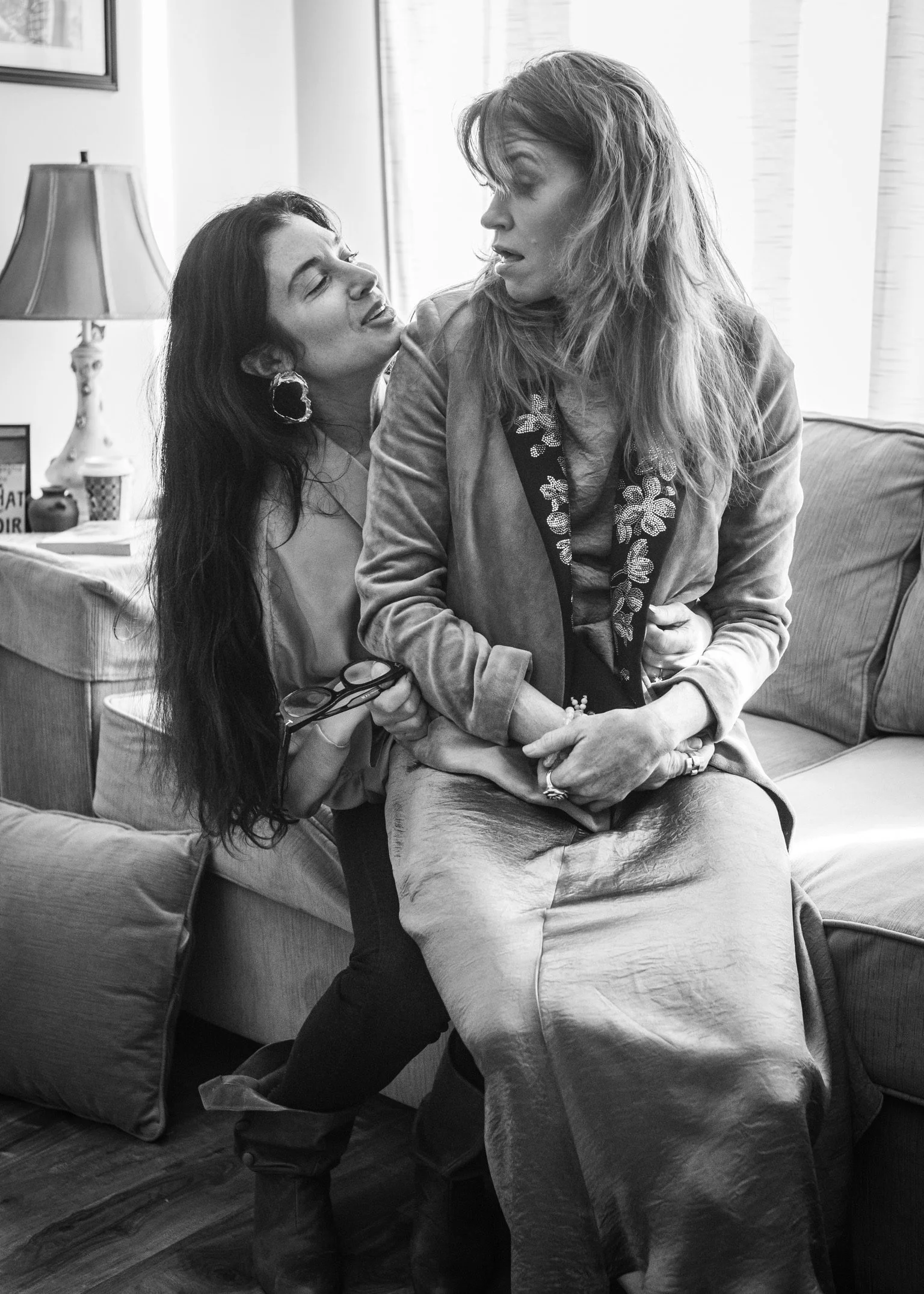
JP: When we're making whatever it is we're making… When we let go of the saleability or [the attachment to if it's] good or all of that shit… that's where the magic is.
ERB: Also, because that is a shifting goalpost. Now it's romantasy du jour — so wolves and fairies. Everything is changing all the time. It's a moving target. Sometimes I'm like, ‘I can [write] wolves and fairies having sex. I can do that in a little forest.’ No, I don't want to do that. I don't even care about the money. Of course, I totally do care about money. Because I am always, like, not having it. But I'm not doing that because that is [following] the goalpost. That is a ridiculous idea. It's like having a perfect body, or having the perfect life, or having the perfect partnership. Those things don't exist.
JP: Yet, we know that, and we forget it.
ERB: Every book that I've written, I’ve been like, ‘Is this a good idea?’
JP: How many books have you [written]?
ERB: This is five. But every time, I’m like, ‘Is this a good idea?’ And then sometimes I'll start a book and [realize], ‘No, it’s not.’ Or I'll come back to a book later. This is one thing that I really do believe in strongly — and I'm doing this even more in my life now — I always have two projects going at once.
JP: This is a masterclass in creativity. She’s dropping gems. I love that, too, [but what’s your philosophy behind that]?
ERB: Well, then you're not so attached to the one thing. Polyamory is silly. I’m zero amorous but polyamorous with projects? Thumbs up. Because one's going to break your heart. As my friend, the novelist Bret Anthony Johnston says, ‘One’s always going to break your heart, and so you move to the other one. You wait for that one to break your heart, and you move back.’
JP: Oh, great. So you literally always just have a broken fucking heart?
ERB: It’s literary polyamory.
JP: I love that because once again, it’s bringing the humor to it. Shit’s hard enough — if you can’t find levity, you’re fucked.
ERB: I also think it's fun to have two things that are different from one another.
JP: You mean like partners, [sexually]?
ERB: Book sex. For a while, I had a ukulele, and I was playing it outside. I was like, I'm going to do something that I'm not good at, which is the ukulele. I can play one song. Very slowly. The poor neighbors are like, ‘The cats are running away.’ [I was] trying to sing Ring of Fire on my tiny little ukulele that Charlie’s written all over.
JP: Do you sing?
ERB: Yeah, I can sing, but I cannot play the ukulele. The voice is great, but the ukulele is terrible. I am not a singer on command. I wanted to be an opera singer.
JP: Your parents are really great, by the way.
ERB: They're so funny.
JP: Religion gets so gross, but at the core of it… I mean, look, I'm a Jew. I'm a terrible Jew because when my dad died, it ended for me. But I think Jesus was a cool dude.
ERB: He was also a Jew, just FYI.
JP: But to be more Christ-like… It's veered away, but your parents remind me of… They embody it. It wasn’t so much talk. It's what you witnessed.
ERB: Well, also, there's a funny story about my dad and revision. So my dad was a pastor. He would write out his sermons. I would white out words and put a different word [in] to be funny. I'd be like, ‘Eggplants.' And he'd be like, ‘And Jesus said to the eggplants.’ It was so funny, and he loved it.
JP: Of course, he did, and [then there’s] me with my daddy issues. I'm like, ‘Don’t cry. Eggplant.’ That is the most random, delicious, quirky, weird, specific, eggplanty memory, but the feeling it invokes [is indescribable]. I love that. …. They’re very religious. But the thing that they instilled in you… I didn't grow up with the perfect childhood. So I didn't have that instilled in me, nor did I witness that with my mom…. And not that in every moment you remember it… But that’s what’s great about our friends, they remind us when we forget. Because all the things that you're talking about… There's no perfect relationship—all the things you said… There are moments when you forget it, and you have to remind me.
ERB: All the time.
JP: But the whole thing with ‘Proof of Life,’ actually, the friend that I'm not friends with anymore is childless. I have many friends who are childless. But this particular friend wore this lens that everyone was judging, and that the world [felt] she had no value, and this whole thing. It was from a poem called ‘Proof of Life.’ It was [exploring], ‘What will show that I matter?’ And I keep thinking I’m done with it. And when the thing happened with the New York Times, the epiphany I had as it was happening was, ‘There I go again. Like, if I finally made this list, then will you love me? Then am I good? Then can I sit at the table?’ And even though I'm like, ‘I'm done.’ And we live in this world now, especially with social media and your relevance [being attached to it] and all this stuff of who matters and who doesn’t. I think it's easy to get trapped in a feeling of ‘I don't matter.’
ERB: I talk about this in the book. The question I get asked the most [over the] last 25 years of being a teacher of writing is, ‘Am I good?’ Not, is my writing good? Am I good? I say, ‘Yes. You are innately good. Your writing and you are not the same thing.’
JP: And then you say your writing is shit. No, just kidding.
ERB: Your writing is not a reflection of your goodness as a person. You are here. You are a person. You are trying.
JP: Isn’t that heartbreaking, that question? It wasn't until my son, and this sounds, again, this was very hard for me, too, because I felt like I should be over it, which is so dumb… No one gets over it. But when my son turned eight, which was how old I was when I stopped being a kid [because my dad passed away—I was like, ‘I have to become the man of the house.’ Why the man? I guess because of my dad. I walked around with ‘I am bad’ my whole life, and I saw Charlie. We both have kids named Charlie, and I had to look away for a while when he turned eight. It was too much. Because I never saw myself as a kid. Until I saw my son. And I thought, ‘Oh my God. I was a baby.’ So it breaks my heart to think of how many of us walk around [wondering], ‘Am I good? Am I bad?’ But ‘Proof of Life’ [addresses], there's nothing. I don't care if this book sells one billion copies. I don't care. If you have kids, if you don’t? I don’t care. There’s nothing that makes you more worthy than anyone else.
ERB: My net worth is probably $25. And that’s okay. How much do you have in your account? Yes, they matter on a practical daily [basis]. They are important. But they're not the only thing. They're not the most important thing in terms of our inherent worthiness. In my classroom, I say, ‘You’re not here to show me that you're good. You and I are working together to make something really beautiful. We're doing it in collaboration. People are always like, ‘I want to bring my strongest story to the workshop.’ I'm like, ‘No. Bring the messiest one because that's fun.’ No writer does it alone. It's such a lie. …. Every book I've ever written has been co-written by friends, by family, by my editor, this one by my students. We do not do it on our own, and we are not meant to.
JP: [You have such a] generosity of spirit. There's no hierarchy, but it's a collaboration. The last thing I just thought of… I was writing something 15 years ago about when I was waitressing. So I probably wrote it when I was [in my] early 30s. I thought I was going to be in academia, a poet in Iowa. I was at the Newsroom waitressing, and people would come in and go, ‘You're still here?’ And I'd be like, ‘No, I'm an apparition.’ A woman said [to me], ‘I would have thought you would have made something of yourself by now.’
ERB: What does that even mean?
JP: In L.A., there are some career servers, but generally it's a stepping stone to something else. I started having a panic attack. I was like, ‘What have I done?’ I couldn’t breathe because I was at NYU. I had scholarships, and I blew it. So as I'm writing this essay about that time, I had the epiphany… At the end of my life, when I ask one final—‘What have I done?’ Let my answer be—‘I‘ve done love.’ Over the years, I’ve revised it. …. Ultimately, your books [and] my book, I hope, is a love letter.
ERB: It is a love letter to the process [and] to the people that have created my life with me as a teacher. It's a conversation across time, history, culture, and experience. Like all writing, like all art. It’s just a big conversation.